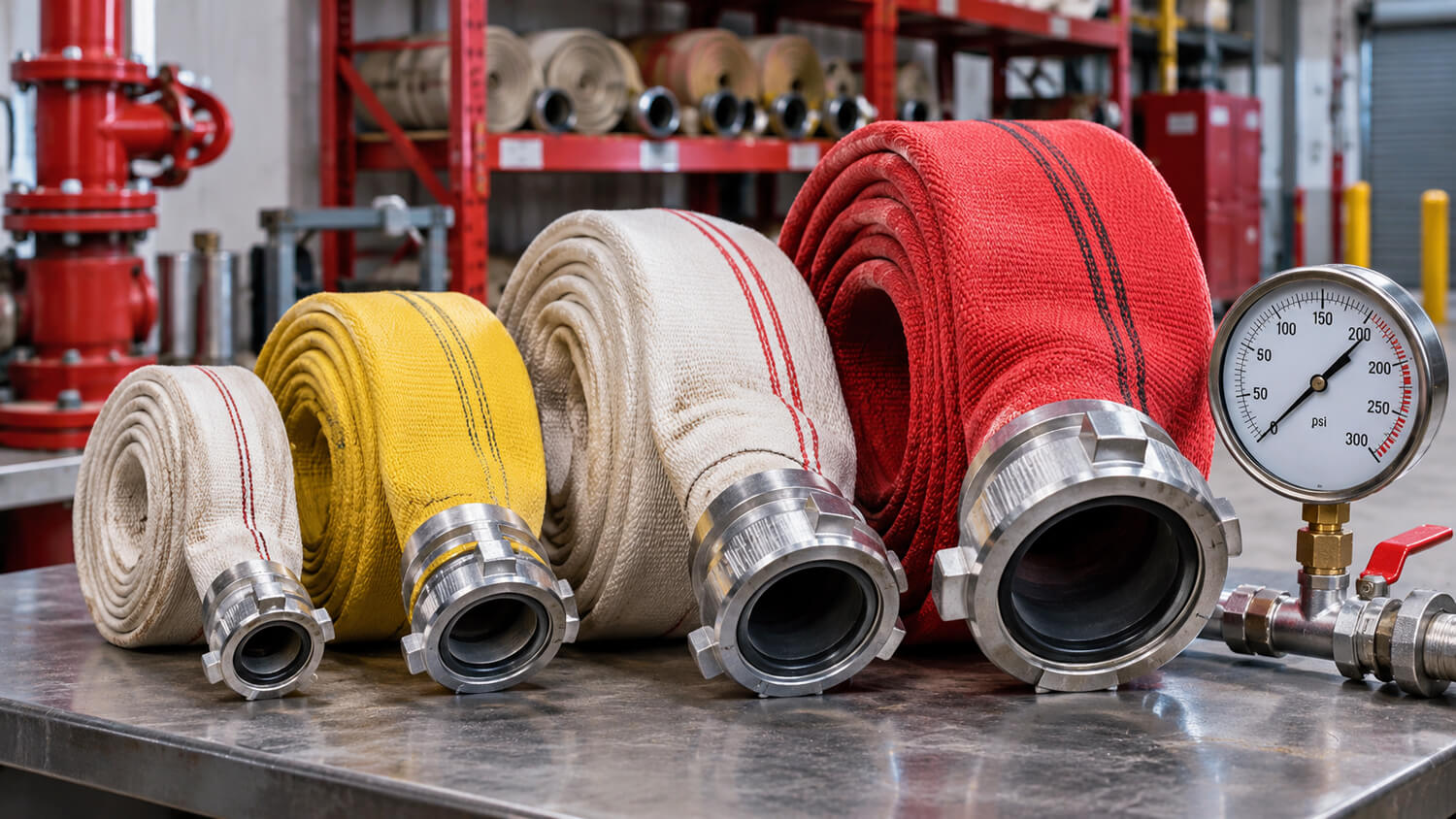
Fire hose sizes and pressure ratings determine how much water a hose can deliver and the pressure it can safely withstand. Common fire hose diameters range from 1 inch to 6 inches, with different pressure classifications for attack, supply, and fixed firefighting systems. The correct selection depends on water flow requirements, operating pressure, hose construction, coupling compatibility, and applicable fire safety standards.
For fire equipment distributors, contractors, and industrial buyers, choosing the wrong hose can lead to poor firefighting performance, equipment damage, and unnecessary replacement costs.
A larger hose isn’t always better. Likewise, a higher burst pressure doesn’t automatically make a product suitable for every application.
You need to understand how different specifications work together before placing a bulk order.
This guide explains common hose dimensions, pressure classifications, material options, international standards, and practical purchasing considerations from a manufacturing and B2B procurement perspective.
Fire Hose Sizes and Pressure Ratings
Fire hose diameter and pressure resistance are two of the most important factors in firefighting equipment selection. Together, they influence water delivery, operational safety, handling, and system compatibility.
Fire hose size generally refers to its nominal internal diameter. Pressure rating describes its ability to withstand water pressure under defined conditions.
However, these two specifications must be considered separately. Two hoses with the same diameter may have very different pressure ratings because of their materials, reinforcement, and manufacturing methods.
Key Fire Hose Specifications at a Glance
| Specification | Common Options | Importance |
|---|---|---|
| Internal diameter | 25–150 mm | Determines water delivery capacity |
| Длина шланга | 15, 20, 25, 30 m | Affects coverage and friction loss |
| Рабочее давление | Model-specific, such as 8–25 bar | Defines permitted operating pressure |
| Proof pressure | According to product standard | Verifies structural integrity |
| Burst pressure | According to product design and standard | Measures resistance to pressure failure |
| Inner lining | PVC, PU, EPDM, rubber | Affects flexibility and durability |
| Outer reinforcement | Single or double jacket | Influences mechanical strength |
| Coupling | Storz, NH, BS, GOST and others | Ensures equipment compatibility |
These specifications are general reference values rather than universal requirements.
When purchasing fire hoses in bulk, you should consider the complete firefighting system rather than a single product specification.
For example, a high-pressure hose may still be unsuitable if its coupling cannot withstand the same operating conditions. Similarly, a small-diameter hose may restrict water delivery even when connected to a powerful fire pump.
From a manufacturing perspective, hose performance depends on several factors. These include yarn strength, weaving density, lining thickness, bonding quality, and coupling assembly.
Small variations in these factors can influence finished product performance.
This is why professional procurement teams should request detailed technical data sheets rather than relying only on product descriptions or photographs.
A properly selected fire hose provides reliable water delivery, reduces equipment replacement costs, and helps your business meet the requirements of local customers and fire protection projects.
Standard Fire Hose Sizes and Dimensions
Fire hoses are available in various diameters to meet different firefighting requirements. Smaller hoses offer better mobility, while larger hoses generally provide greater water delivery capacity.
International buyers should understand both imperial and metric measurements. Many countries use inches, while European and Asian markets frequently use millimeters.
Standard Fire Hose Size Chart
| Hose Size | Nominal Diameter | Типовые применения |
|---|---|---|
| 1 inch | 25 mm | Forestry and lightweight firefighting |
| 1¼ inches | 32 mm | Specialized firefighting systems |
| 1½ inches | 38–40 mm | Fire cabinets and lightweight attack lines |
| 1¾ inches | 44–45 mm | Municipal attack hoses |
| 2 inches | 50–52 mm | Commercial and industrial firefighting |
| 2½ inches | 63–65 mm | Fire hydrants and heavy-duty attack lines |
| 3 inches | 75–76 mm | Industrial delivery and water transfer |
| 4 inches | 100–102 mm | Large-diameter supply lines |
| 5 inches | 125–127 mm | High-volume water supply |
| 6 inches | 150–152 mm | Large-scale industrial water transfer |
Nominal metric sizes may vary according to regional standards and product designs.
Small-Diameter Fire Hoses
Small-diameter hoses are commonly used where mobility, compact storage, and lower weight are important.
They are suitable for certain forestry operations, building firefighting installations, and specialized fire protection applications.
Their main advantage is easy handling. However, their water delivery capacity is generally lower than that of larger hoses.
Medium-Diameter Fire Hoses
Medium-diameter products offer a practical balance between water flow and flexibility.
The 1½-inch, 1¾-inch, 2-inch, and 2½-inch sizes are widely encountered in commercial and municipal firefighting.
For distributors, these sizes are often important categories when developing a product portfolio.
Large-Diameter Fire Hoses
Large-diameter hoses are designed primarily for transferring substantial volumes of water.
They are commonly used to connect water sources, firefighting vehicles, pumps, and industrial equipment.
Their larger dimensions can reduce friction loss at the same flow rate. However, they require more storage space and become considerably heavier when filled with water.
You should also confirm hose length before ordering. Common commercial lengths include 15, 20, 25, and 30 meters. North American products are also frequently supplied in lengths of 50, 75, or 100 feet.
Never assume that nominally equivalent imperial and metric sizes have identical manufacturing dimensions or coupling compatibility.
Understanding Fire Hose Pressure Ratings
Fire hose pressure ratings describe different aspects of pressure resistance. Understanding these differences helps you compare products correctly and avoid costly purchasing mistakes.
A common problem occurs when buyers compare working pressure from one supplier with burst pressure from another. These figures represent very different performance characteristics.
Working Pressure
Working pressure is the maximum operating pressure permitted by the manufacturer under specified service conditions.
For example, a hose with a declared working pressure of 16 bar is intended to operate within that limit and its other approved conditions.
The complete assembly, including couplings and connected equipment, must also be suitable for the operating pressure.
Proof Pressure
Proof pressure is a specified test level used to verify structural integrity.
During factory testing, the hose is exposed to controlled hydraulic pressure according to the applicable standard and test procedure.
The product must meet the relevant acceptance criteria without unacceptable leakage, damage, or deformation.
Proof pressure is not an approved continuous operating pressure.
Service Test Pressure
Service test pressure is used when evaluating hose condition under the applicable inspection and maintenance standard.
It is particularly relevant to firefighting organizations responsible for equipment already in service.
A service test rating should not automatically be interpreted as the maximum working pressure.
Burst Pressure
Burst pressure describes the pressure associated with hose failure during a destructive test, or a specified minimum resistance to bursting.
It helps manufacturers evaluate the strength of hose construction and reinforcement.
Illustrative Fire Hose Pressure Classification
Example specification: 15-bar working pressure
Рабочее давление
15 bar
Proof pressure
22.5 bar
Minimum burst pressure
45 bar
0 bar15 bar30 bar45 bar
This example illustrates three different pressure classifications. Test and burst pressures are not permissible operating pressures. Actual values depend on the product and applicable standard.
These distinctions are essential when preparing technical quotations, comparing factory offers, and responding to international tenders.
Always ask your supplier to identify each pressure value clearly. A quotation that simply states “pressure: 30 bar” does not provide enough information for professional procurement.
Fire Hose Size and Pressure Rating Comparison Chart
Pressure requirements vary according to hose construction, intended application, and applicable standards. Therefore, hose diameter alone cannot determine its pressure resistance.
A 65 mm fire hose, for example, may be manufactured for fixed installations, industrial applications, or municipal firefighting. Each product can have different technical requirements.
The following table provides an illustrative comparison of pressure specifications that buyers may encounter in commercial fire hose procurement.
| Nominal Diameter | Example Working Pressure | Example Proof Pressure | Example Minimum Burst Pressure |
|---|---|---|---|
| 25 mm | 8 bar | 12 bar | 24 bar |
| 38 mm | 10 bar | 15 bar | 30 bar |
| 50 mm | 13 bar | 19.5 bar | 39 bar |
| 65 mm | 15 bar | 22.5 bar | 45 bar |
| 65 mm | 16 бар | 24 bar | 48 bar |
| 75 mm | 20 bar | 30 bar | 60 bar |
| 100 mm | 10 bar | 15 bar | 30 bar |
| 125 mm | 13 bar | 19.5 bar | 39 bar |
| 150 mm | 10 bar | 15 bar | 30 bar |
The table contains illustrative specifications, not mandatory ratings or certified Yinglong Fire product data. Actual pressure ratios must follow the selected product standard and verified manufacturer specifications.
Fire Hose Pressure Conversion Chart
International buyers frequently receive technical documents using bar, PSI, and MPa.
Understanding these units helps prevent specification errors when purchasing equipment from overseas manufacturers.
| Pressure (bar) | Pressure (PSI) | Pressure (MPa) |
|---|---|---|
| 8 | 116 | 0.8 |
| 10 | 145 | 1.0 |
| 13 | 189 | 1.3 |
| 15 | 218 | 1.5 |
| 16 | 232 | 1.6 |
| 20 | 290 | 2.0 |
| 25 | 363 | 2.5 |
| 30 | 435 | 3.0 |
| 45 | 653 | 4.5 |
| 60 | 870 | 6.0 |
The basic conversion relationships are:
- 1 bar ≈ 14.504 PSI
- 1 MPa = 10 bar
- 1 MPa ≈ 145.04 PSI
Real-World Pressure Specification Examples
Published manufacturer specifications demonstrate how different hose categories can have different test pressure values.
| Commercial Hose Example | Service Test | Proof Test | Burst Test |
|---|---|---|---|
| 1½-inch single-jacket cabinet hose | 250 PSI | 500 PSI | 750 PSI |
| 6-inch rubber-covered supply hose | 225 PSI | 450 PSI | 675 PSI |
These examples come from published commercial product specifications. They should not be interpreted as universal requirements or working pressure recommendations. Industrial Hose+1
For wholesale purchasing, we recommend using a consistent specification sheet across all suppliers. This makes it easier to compare prices, materials, testing requirements, and product performance.
Most importantly, compare the same type of pressure rating when evaluating different quotations.
How Hose Diameter Affects Water Flow and Friction Loss
Hose diameter plays an important role in determining water delivery performance. Water experiences resistance as it moves through a hose. This resistance creates a pressure drop known as friction loss.
Smaller hoses generally create more friction loss than larger hoses carrying the same volume of water over the same distance.
The actual pressure drop also depends on the internal surface, hose construction, length, fittings, and flow rate.
Fire Hose Diameter and Internal Flow Area
The following chart compares the theoretical internal cross-sectional area of different hose diameters.
Relative Internal Flow Area by Diameter
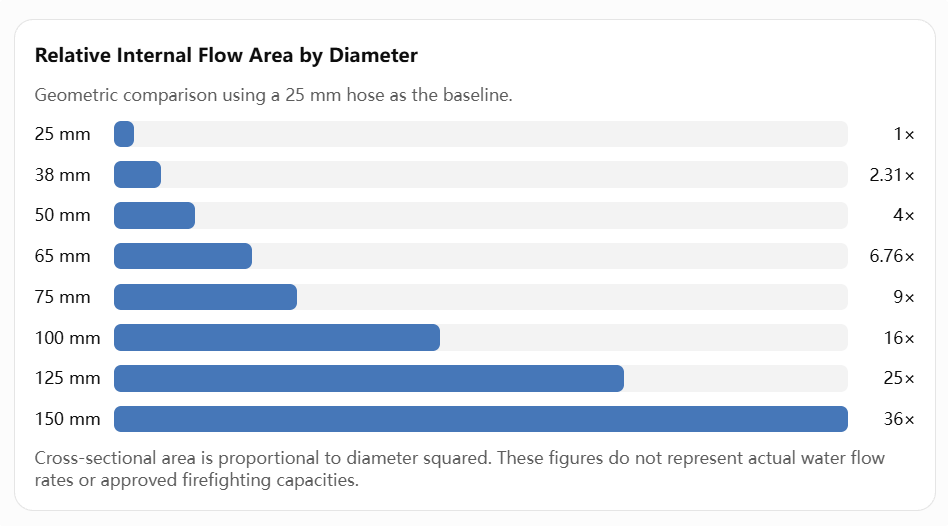
Cross-sectional area is proportional to diameter squared. These figures do not represent actual water flow rates or approved firefighting capacities.
The chart demonstrates why increasing the hose diameter can significantly increase its internal flow area.
For example, a 100 mm hose has approximately four times the theoretical cross-sectional area of a 50 mm hose. However, its actual water delivery capacity depends on the entire hydraulic system.
Main Factors Affecting Friction Loss
- Internal hose diameter
- Total hose length
- Water flow rate
- Inner lining smoothness
- Coupling and fitting restrictions
- Bends and kinks
- Changes in hose dimensions under pressure
Elevation changes also affect the pressure available at the discharge point, although this is separate from friction loss.
Why Larger Hoses Are Not Always Better
A larger hose can improve water transfer efficiency, but it also creates practical challenges.
It generally weighs more when filled with water. It may require additional personnel, larger storage compartments, and different coupling systems.
For procurement teams, the goal should be to balance hydraulic performance with handling requirements.
We recommend requesting verified friction loss data at several flow rates when evaluating hoses for demanding applications.
This information is more useful than a simple claim of high flow capacity.
Final pump pressure, hose diameter, nozzle selection, and operating conditions should be determined by qualified firefighting or fire protection professionals.
How Fire Hose Materials Affect Pressure Resistance
Fire hoses are composite products. They combine a flexible inner lining with textile reinforcement and, in some designs, a protective outer covering.
Each material performs a specific function.
The lining provides a water-resistant passage. The textile jacket helps contain internal pressure. The external surface protects the hose against abrasion and environmental damage.
Common Fire Hose Material Comparison
| Материал | Main Characteristics | Typical Advantages |
|---|---|---|
| Polyester yarn | Strong synthetic textile | Reinforcement and dimensional stability |
| Nylon yarn | Tough, flexible textile | Mechanical strength and abrasion resistance |
| PVC lining | Lightweight thermoplastic | Cost efficiency and flexibility |
| PU lining | Thin, flexible polyurethane | Low weight and wear resistance |
| EPDM lining | Synthetic rubber | Weathering and ozone resistance |
| Nitrile rubber | Oil-resistant synthetic rubber | Suitable for selected industrial environments |
| Nitrile/PVC cover | Protective composite covering | Abrasion and environmental resistance |
Material performance depends on the exact formulation, product construction, and verified test results.
Single Jacket vs. Double Jacket Fire Hoses
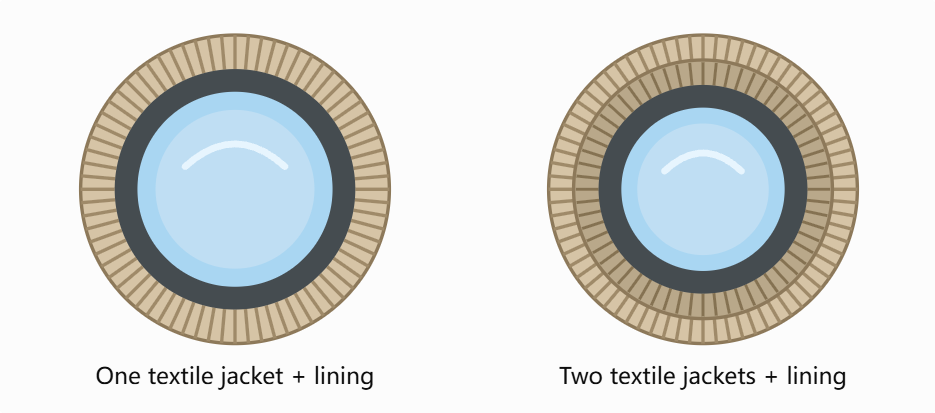
Шланг с однослойной оболочкой
Lightweight construction, compact storage, and easier handling for suitable applications.
Шланг с двойной оболочкой
Additional textile reinforcement and protection for more demanding service conditions.Simplified cross-sectional illustrations, not to scale.
Single-jacket hoses contain one woven textile layer. They are often selected for applications where weight, storage space, and handling are important.
Double-jacket hoses use two textile layers. This construction can provide additional mechanical protection and greater pressure resistance, depending on the design.
However, a double-jacket structure alone does not guarantee a particular pressure rating.
Manufacturing Quality Matters
From a manufacturing perspective, raw material selection is only the beginning. Several production factors influence finished hose quality:
- Yarn tensile strength and consistency
- Weaving density and uniformity
- Inner lining thickness
- Bonding between reinforcement and lining
- Dimensional consistency
- Coupling attachment quality
- Hydraulic testing performance
Poor bonding can cause separation between the lining and textile jacket. Uneven reinforcement may create weak areas.
These manufacturing defects are not always visible during a basic visual inspection.
If your business purchases hoses regularly, ask for consistent material specifications, approved samples, and relevant batch inspection records.
You can also read our detailed guide to single jacket vs. double jacket fire hoses to better understand their construction and application differences.
International Fire Hose Standards and Certifications
Firefighting equipment must meet the technical and regulatory requirements of its destination market.
International standards establish requirements for product design, testing, construction, marking, and maintenance. However, different standards cover different product categories.
As an importer or distributor, you should identify the required standard before selecting a hose model.
Major International Fire Hose Standards
| Стандартный | Primary Market or Use | Main Scope |
|---|---|---|
| NFPA 1960 | North America and international projects | Fire hose design, construction and related equipment |
| NFPA 1930 | North America and international projects | Equipment use, inspection and maintenance |
| NFPA 1961 | Existing specifications and legacy tenders | Fire hose design and testing |
| NFPA 1962 | Existing specifications and legacy tenders | Fire hose care and service testing |
| UL 19 | Markets requiring UL-certified products | Lined fire hoses and hose assemblies |
| BS 6391 | UK and international projects | Layflat firefighting delivery hoses |
| EN 14540 | European and international projects | Layflat hoses for fixed firefighting systems |
| EN 694 | European markets | Semi-rigid hoses for fixed systems |
NFPA Fire Hose Standards
NFPA has consolidated several older standards into broader documents.
The 2024 edition of NFPA 1960 incorporates the former NFPA 1961 fire hose design and construction requirements. NFPA 1930 incorporates the former NFPA 1962 requirements for equipment use, inspection, and maintenance. nfpa.org+2
Buyers can review the official NFPA 1960 standard information for further details.
European Fire Hose Standards
EN 14540 covers non-percolating layflat hoses for fixed firefighting installations.
The 2014 edition covers internal diameters from 25 mm to 52 mm, with a maximum working pressure of 1.5 MPa, or 15 bar. EN+1
BS 6391:2009 covers specified layflat delivery hose types intended for working pressures not exceeding 15 bar. Tienda AENOR+1
These requirements apply within their defined product categories.
Сертификация UL
UL 19 addresses lined fire hoses and hose assemblies. Certification requirements consider hose construction, product marking, and relevant pressure classifications. UL Solutions
You should distinguish between a manufacturer claiming compliance with a standard and a product holding independent certification.
Before placing an order, verify the certificate holder, product model, diameter, pressure classification, and certification status.
A certificate covering one hose model does not necessarily cover every product manufactured by the same factory.
This verification is particularly important when supplying government projects, commercial buildings, and regulated industrial facilities.
Choosing the Right Fire Hose for Different Applications
Every firefighting environment creates different demands on equipment. A hose designed for a building fire cabinet may not provide the same performance needed for municipal operations.
Selecting a hose based on its intended application helps improve reliability and avoid unnecessary purchasing costs.
Fire Hose Application Selection Chart
| Приложение | Common Nominal Sizes | Main Selection Considerations |
|---|---|---|
| Коммерческие здания | 25–65 mm | Cabinet compatibility and local regulations |
| Системы пожарных гидрантов | 38–75 mm | Outlet compatibility and system pressure |
| Municipal firefighting | 38–75 mm | Flow, handling and mechanical strength |
| Промышленные объекты | 50–100 mm | Abrasion and environmental resistance |
| Forestry firefighting | 25–38 mm | Low weight and mobility |
| Marine firefighting | 38–65 mm | Environmental resistance and marine approval |
| Water supply operations | 75–150 mm | High-volume transfer and friction loss |
Actual selection must follow the system design, product certification, and applicable regulations.
Commercial Buildings and Fire Cabinets
Fire protection systems in hotels, hospitals, shopping centers, and office buildings require reliable equipment that fits the approved installation.
Important considerations include cabinet dimensions, hose length, valve connections, and local fire protection codes.
Compact hose construction can be helpful where storage space is limited.
Municipal Firefighting
Municipal fire departments often require different hose categories for direct firefighting and water supply.
Their purchasing decisions may focus on durability, flexibility, pressure classification, weight, and hydraulic performance.
Compatibility with existing firefighting vehicles is also important.
Industrial Fire Protection
Industrial facilities can expose hoses to rough surfaces, chemicals, oils, outdoor weather, and demanding service conditions.
Rubber-covered products or reinforced jacket designs may be appropriate for certain environments.
However, chemical resistance must be verified against the actual substances present at the site.
Marine and Offshore Applications
Marine environments create additional challenges, including moisture, salt exposure, and corrosion.
Buyers should confirm that hose materials, couplings, and approvals are suitable for the intended vessel or offshore installation.
Forestry and Water Supply Applications
Forestry operations often prioritize low equipment weight and portability. Large-scale water supply operations place greater emphasis on flow capacity and pressure loss.
For distributors serving multiple industries, we recommend organizing inventory by application category rather than diameter alone.
This approach helps your customers identify suitable products more efficiently and reduces the risk of incorrect product recommendations.
What B2B Buyers Should Check Before Ordering Fire Hoses
Purchasing directly from a fire hose manufacturer offers several potential advantages. These include technical communication, specification control, OEM customization, and long-term supply cooperation.
However, successful procurement requires more than comparing unit prices.
Fire Hose Procurement Checklist
| Purchasing Item | Information to Confirm |
|---|---|
| Приложение | Cabinet, attack, supply, industrial or forestry |
| Internal diameter | Nominal size and permitted tolerance |
| Длина шланга | Required length and measurement method |
| Рабочее давление | Declared maximum operating pressure |
| Proof pressure | Applicable factory test requirement |
| Burst pressure | Verified minimum burst resistance |
| Jacket construction | Single jacket, double jacket or covered hose |
| Inner lining | PVC, PU, EPDM or other rubber |
| Coupling material | Brass, aluminum alloy or specified alternative |
| Coupling type | Storz, NH, BS, GOST, Machino or other connection |
| Сертификация | Required standard, edition and approval scope |
| Маркировка продукции | Size, pressure, batch number and required markings |
| Quality inspection | Inspection records and test reports |
| OEM requirements | Color, branding, labeling and packaging |
| Коммерческие условия | MOQ, lead time, delivery and warranty |
Verify Factory Quality Control
Professional hose manufacturing requires consistent control throughout production.
Typical Fire Hose Manufacturing and Quality Control Process
- Raw Material InspectionCheck reinforcement yarn, lining materials and coupling specifications.
- Textile Jacket WeavingControl weaving density, dimensions and textile uniformity.
- Inner Lining Production and BondingCheck lining thickness and bonding quality.
- Cutting and Dimensional InspectionVerify hose length and applicable dimensional tolerances.
- Coupling AssemblyInspect coupling compatibility, attachment and sealing.
- Hydraulic and Performance TestingPerform required production tests and sample-based destructive tests under controlled conditions.
- Final Inspection and PackagingCheck markings, appearance, documentation and shipment requirements.
For repeated orders, maintaining consistent quality is just as important as achieving acceptable results with the initial samples.
Ask whether changes to materials, construction, or suppliers require your approval. Establish clear acceptance criteria before mass production begins.
You can learn more about the production process in our fire hose manufacturing guide.
Prepare a Complete Request for Quotation
A detailed RFQ allows manufacturers to provide more accurate quotations.
Instead of simply requesting a price for 1,000 pieces of 2½-inch fire hose, include the required pressure classification, length, lining material, jacket construction, coupling type, and certification.
You should also identify the destination country and intended application.
Providing this information reduces communication delays and helps prevent incorrect product configurations.
At Огонь Инлун, we supply firefighting equipment for international B2B customers. You are welcome to share your technical specifications, tender documents, or purchasing requirements with our team for product matching and quotation.
Часто задаваемые вопросы
What are the most common fire hose sizes?
Common fire hose sizes include 1 inch, 1½ inches, 1¾ inches, 2 inches, 2½ inches, 3 inches, 4 inches, 5 inches, and 6 inches. Smaller sizes are often used for mobile firefighting and fixed systems. Larger sizes are generally selected for high-volume water delivery.
What is the standard working pressure of a fire hose?
There is no universal working pressure for every fire hose. Commercial products may have ratings such as 8, 10, 13, 15, 16, 20, or 25 bar. The correct rating depends on the hose design, intended application, operating environment, and applicable product standard.
What is the difference between working pressure and burst pressure?
Working pressure defines the permitted operating pressure under specified conditions. Burst pressure describes destructive failure resistance or a specified minimum burst threshold. A hose must never be operated at its burst pressure. Buyers should compare working pressure separately from test and burst pressure.
Is a 16-bar fire hose better than a 10-bar fire hose?
Not necessarily. A 16-bar hose has a higher declared working pressure when both ratings are defined under comparable conditions. However, the better product depends on system requirements, flexibility, weight, durability, coupling compatibility, and certification. Purchasing an unnecessarily high pressure rating may increase costs without providing meaningful benefits.
What size fire hose is commonly used with fire hydrants?
Hoses with nominal diameters of 38 mm, 50 mm, and 65 mm are commonly encountered in hydrant-based firefighting systems. Larger sizes may also be used in industrial and municipal installations. The correct diameter depends on the hydrant outlet, required water flow, system design, and local regulations.
How much PSI is a 20-bar fire hose?
Twenty bar equals approximately 290 PSI or 2 MPa. When comparing international technical specifications, buyers should confirm whether this figure represents working pressure, proof pressure, service test pressure, or burst pressure. Converting the units alone does not establish equivalent product performance.
Does a double-jacket fire hose always have a higher pressure rating?
No. Double-jacket construction can improve reinforcement and mechanical protection, but actual pressure resistance depends on yarn strength, weaving density, lining materials, and manufacturing quality. A well-designed single-jacket product may have a higher rating than another double-jacket hose. Always compare verified technical data.
How do manufacturers test fire hose pressure resistance?
Manufacturers use controlled hydraulic testing to evaluate pressure resistance, leakage, and structural integrity. Depending on the applicable standard, additional tests may include burst resistance, dimensional stability, abrasion, and lining adhesion. Destructive burst tests are normally performed on designated samples rather than products intended for shipment.
Can fire hoses be customized for wholesale and OEM orders?
Many manufacturers offer customization options involving hose diameter, length, jacket construction, lining material, color, couplings, branding, and packaging. However, customization must remain within verified technical capabilities. Changes affecting certified product construction may require additional testing or approval before commercial distribution.
How can I choose a reliable fire hose manufacturer?
Evaluate the manufacturer’s production capabilities, quality management, technical documentation, testing equipment, and relevant product certifications. Request samples and confirm that mass-production specifications match the approved product. A reliable supplier should also communicate clearly about lead times, technical limitations, inspection requirements, and after-sales responsibilities.
Заключение
Understanding fire hose sizes and pressure ratings is essential for selecting suitable firefighting equipment and building a reliable supply chain.
Although hose diameter influences water delivery, pressure resistance depends on product construction, reinforcement, materials, and manufacturing quality. Neither specification should be considered independently.
For international distributors, wholesalers, and fire protection contractors, making an informed purchasing decision can provide several long-term benefits:
- Better compatibility with existing firefighting systems
- More consistent product quality
- Reduced purchasing and replacement costs
- Improved compliance with project requirements
- Fewer product selection errors
- Greater confidence among end customers
Before placing a bulk order, confirm the intended application, nominal diameter, pressure classification, construction materials, coupling specifications, and required certifications.
Working directly with a professional manufacturer can also help you identify suitable product configurations and simplify technical communication.