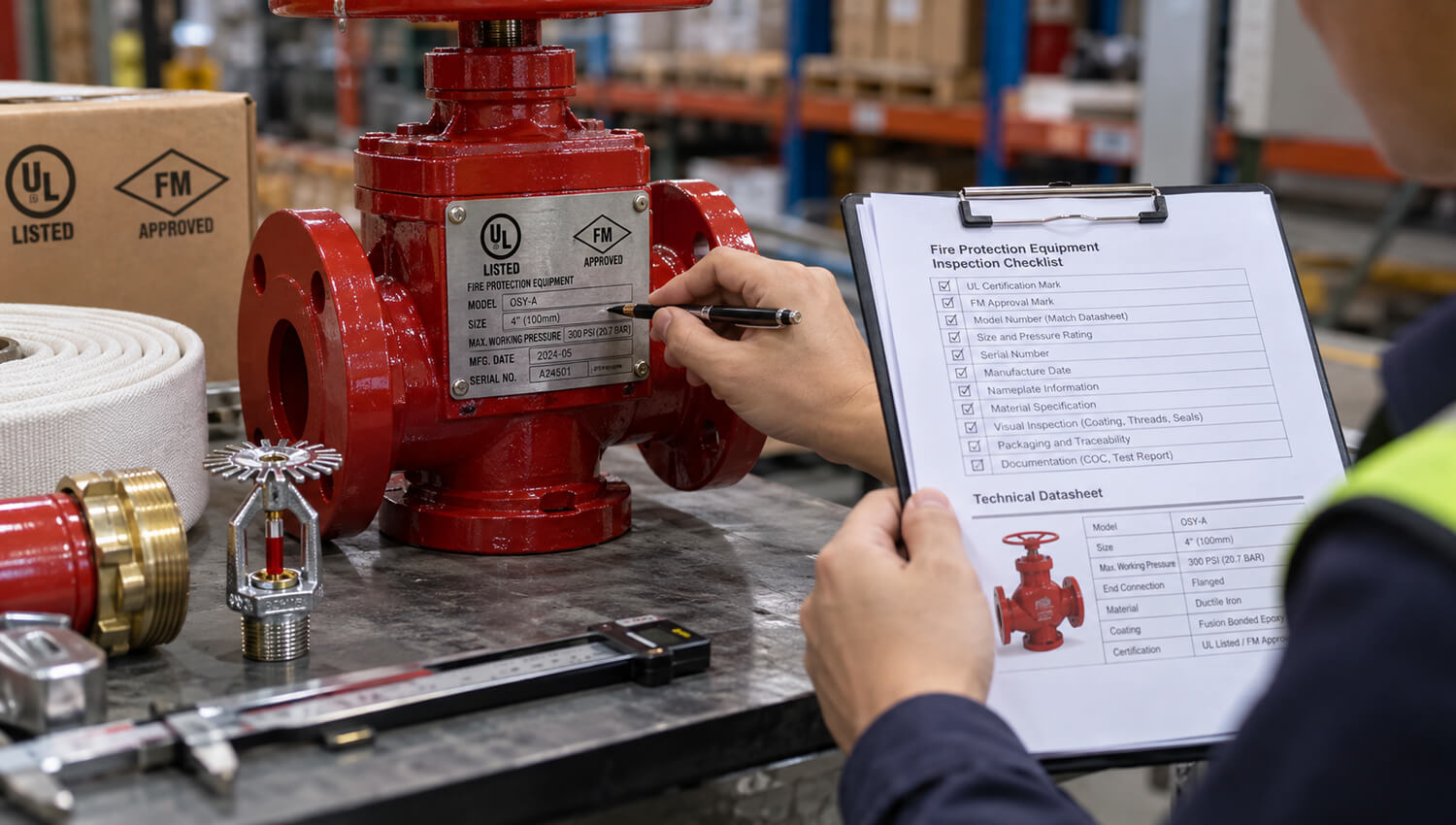
To verify UL and FM fire equipment certificates, check the product in the official UL Product iQ or FM Approval Guide database. Match the manufacturer, model number, certification status, and technical ratings with the equipment you plan to buy. Confirm that the certification covers the exact product and application. Don’t rely on a supplier’s certificate image alone.
For fire equipment importers and distributors, this verification is a critical purchasing step.
A certificate may look professional. It may contain a logo, document number, and official stamp. Yet those details don’t prove that every product in a supplier’s catalog is certified.
There are several risks to consider:
- The certificate may belong to a different manufacturer.
- The approved model may differ from the quoted product.
- The certification may no longer be valid.
- The certificate may cover only certain product sizes or configurations.
- The supplier may use an authentic certificate to promote an uncertified product.
These problems can affect project acceptance, insurance requirements, and customer confidence.
The Essential Verification Process
*Collect the certificate and product details
*Search the official UL or FM database
*Match the company, model, and approved ratings
*Confirm current status and application limits
*Check the delivered product and retain evidence
This process helps you avoid buying equipment that fails a project inspection.
It also gives you stronger evidence when dealing with engineering consultants and contractors.
For larger orders, complete these checks before paying the production deposit. Finding a problem after shipping is far more expensive.
The aim is simple: confirm that the equipment you order matches the certified equipment described in the official records.
Understanding UL Listing and FM Approval for Fire Protection Equipment
UL and FM are two important certification systems used in the fire protection industry. Both help buyers evaluate products through independent testing and certification.
However, they are not identical.
UL Solutions evaluates products against applicable safety and performance requirements. FM Approvals focuses on products and systems used to help prevent property loss.
For overseas buyers, understanding this difference helps you choose equipment that meets your project’s specifications.
What Does UL Listed Mean?
UL Listed generally means that UL Solutions has evaluated representative product samples against applicable requirements.
Certified products are also subject to ongoing follow-up procedures.
A UL certification applies to defined products and conditions. It doesn’t automatically cover every model made by the same company.
UL Solutions also uses an enhanced UL Certified Mark. Its legacy Listed and Classified Marks remain valid.
What Does FM Approved Mean?
FM Approved means a product or service has met applicable FM Approvals requirements.
The certification is widely used in commercial and industrial fire protection projects.
FM Approvals evaluates products for their intended performance and loss prevention applications. Certified products are listed in its official directories.
UL vs FM Certification Comparison
| Характеристика | Сертификация UL | FM-сертификация |
|---|---|---|
| Certification organization | UL Solutions | FM Approvals |
| Main focus | Applicable safety and performance requirements | Property loss prevention and performance |
| Official database | Product iQ | Approval Guide |
| Common terminology | UL Listed, UL Classified, UL Certified | Одобрено FM |
| Product coverage | Defined certified models and categories | Defined approved models and applications |
| Buyer verification | Check certification records and markings | Check approval listings and restrictions |
| Market relevance | Often required in North American and international projects | Common in industrial and insurance-driven projects |
Does Every Fire Product Need Both Certifications?
No. Requirements depend on the project, country, applicable standards, and approval authority.
Some projects specify UL certification. Others require FM Approval. Certain projects require both.
Neither certification automatically replaces the other.
For example, a contractor purchasing fire sprinklers may need a particular sprinkler model with both approvals.
An equipment distributor serving another market may have different requirements.
Before ordering, ask your project consultant which certificates and standards are mandatory.
This helps prevent unnecessary costs and reduces approval delays.
What Documents Should You Request Before Verification?
Before searching any certification database, collect clear information from your supplier.
A professional manufacturer should be able to identify the products being offered and provide relevant technical documentation.
You don’t need a huge document package at the first stage. However, you do need enough information to confirm the exact product.
Essential Supplier Documentation
| Required Document | What You Should Check |
|---|---|
| Certification copy or listing reference | Certification body, company, and covered products |
| Product datasheet | Model, dimensions, pressure, materials, and performance |
| Product catalog | Product family and model identification |
| Nameplate or marking photo | Manufacturer, model, certification mark |
| Technical drawing | Dimensions, connections, and configuration |
| Product model list | Exact model codes included in the certification |
| Manufacturing information | Factory identity and relationship to the certificate holder |
| Installation instructions | Installation limits and intended applications |
The supplier should also confirm whether the quoted product is certified or merely manufactured to a similar standard.
These are different claims.
Certificate, Product Label, and Datasheet
Consider a fire protection valve offered by a supplier.
Its datasheet shows a nominal diameter of DN100 and a rated working pressure of 16 bar.
The supplier also provides an FM certificate for the same valve family.
That’s a useful starting point, but it isn’t enough.
You still need to confirm that the exact DN100 configuration and relevant pressure rating are included in the approval record.
A family certificate may have limits on size, installation position, or application.
It’s also important to identify the legal manufacturer.
Some exporters are trading companies. Others are manufacturers operating several factories.
A trading company can legitimately supply approved products made by another business. However, it must not present another manufacturer’s certification as its own.
Ask for a clear explanation of the relationship.
For your purchase records, save the quotation, datasheet, certificate reference, and official listing evidence together.
This creates a basic compliance file that your engineering team can review before approving the order.
How to Check UL Certification Using Product iQ
UL Solutions provides an official online certification database called Product iQ.
This is one of the most useful tools for buyers who need to verify fire protection products.
You can search certification records using a company name, product model, file number, or product category information.
UL Solutions confirms that Product iQ provides certification records and related product guidance.
Access the Official UL Database
UL Product iQ
Official certification lookup
Search for certified manufacturers, product models, file numbers, and category information.
Step-by-Step UL Certificate Verification
- Open the official Product iQ website.
- Create a free account or sign in if required.
- Enter the supplier’s UL file number or company name.
- Open the relevant certification record.
- Find the product category and model information.
- Compare the listing with your datasheet and quotation.
- Review the certification details and any special conditions.
A company name search may return several results.
For example, one manufacturer might have certificates for sprinklers, alarm valves, and fire pump components.
The existence of these records doesn’t mean every product the company sells is UL Certified.
Check the UL File Number
A UL file number is an important reference for tracing certification information.
However, a file number may relate to several products or records.
Don’t stop once the number produces a search result.
Open the relevant record and confirm the actual model.
Check whether the product belongs to a certified end-product category or a component recognition program.
This distinction matters for project acceptance.
Verify the Certification Status
A scanned certificate might have been issued several years ago.
That doesn’t automatically mean it has expired. UL product certifications do not all work like documents with a simple annual expiration date.
Instead, verify the current certification record and its scope.
If the record is missing or unclear, contact UL Solutions directly.
UL provides a customer support channel for questions about certification validity.
For procurement teams, this final confirmation can prevent an expensive mistake before production begins.
How to Check FM Approval Using the Approval Guide
FM Approvals maintains an official database known as the Approval Guide.
It contains information about products and services that have passed applicable FM approval requirements.
The database also provides technical details and application information for approved products.
According to the official Approval Guide, it contains current information about approved products and their intended use.

Approval Guide
Access the Official FM Approval Guide

FM Approval Guide
Official FM Approved product directory
Check approved products, manufacturers, technical information, and listing conditions.
Step-by-Step FM Approval Verification
- Visit the official Approval Guide website.
- Register or sign in to access the searchable directory.
- Search by manufacturer, product model, or product category.
- Open the matching product listing.
- Review the stated technical information.
- Confirm that the model and its intended application match your purchase.
- Save or print the relevant record for your procurement file.
The search results may include different product versions.
For instance, a manufacturer may offer several types of fire protection valves.
One version may be FM Approved, while another version is not.
Even when products look similar, they may have different internal components or performance ratings.
That’s why a model-level check matters.
Review Application Restrictions
FM approval records may include product-specific installation conditions, performance ratings, or application limits.
These details can affect whether the equipment is suitable for your project.
Suppose you are purchasing equipment for an industrial fire protection system.
The project calls for a defined operating pressure and pipe arrangement.
You should compare those requirements with the approved product’s information.
An approved product isn’t automatically suitable for every fire protection application.
If the database information doesn’t match the supplier’s documents, request clarification.
Never change a model description on a purchase order merely to make it resemble an approved listing.
For larger orders, ask the manufacturer to provide the official listing reference alongside its technical datasheet.
This makes approval reviews easier for engineering consultants, insurance representatives, and your customers.
How to Confirm the Exact Certified Product Model and Scope
Finding a company in a certification database is only the beginning.
The most important question is whether the specific product you’re purchasing is covered.
A manufacturer may have many product models. Some may be certified, while others may be designed for different markets.
Match the Product Identification
Start with the complete model code.
Do not rely only on a product name such as “butterfly valve” or “fire sprinkler.”
The model code may identify important differences, including materials, connections, and operating characteristics.
Compare these details:
- Manufacturer and brand name
- Product model and series
- Nominal diameter or size range
- Rated working pressure
- Temperature rating
- Connection type
- Material and configuration, where specified
- Approved application and installation conditions
Understand Product Family Restrictions
Imagine a supplier offers three butterfly valves.
| Model | Nominal Size | Quoted Pressure | Verification Result |
|---|---|---|---|
| BV-100A | DN100 | 16 bar | Confirmed in the example listing |
| BV-150A | DN150 | 16 bar | Requires separate model confirmation |
| BV-200B | DN200 | 16 bar | Different series; not yet verified |
Illustrative purchasing example only. These model codes are hypothetical and do not represent actual certifications.
Even when the pressure ratings match, the certification coverage may differ.
A larger valve could have different internal parts. A modified design may also require a separate evaluation.
For that reason, never assume that certification applies to the entire product family.
Check the Installation Application
A product might be approved only for certain applications.
For example, the manufacturer may specify restrictions involving water supply conditions, installation position, or system design.
You should compare these restrictions with your project’s engineering requirements.
If you’re buying a sprinkler, confirm its orientation, temperature classification, response type, and coverage requirements.
For a fire pump, review the listed performance and configuration.
For valves, confirm the approved connection type and other relevant limits.
The goal is to create a clear match between your purchase order and the published certification information.
Where any detail remains uncertain, obtain confirmation from the certification body or the appropriate project approval authority before placing the order.
How to Identify Fake, Expired, or Misleading Certification Claims
Counterfeit certification marks and misleading product claims are real risks in international fire equipment purchasing.
A polished PDF is not proof of compliance.
In July 2026, UL Solutions warned about unauthorized UL marks on certain pipe fittings used in fire sprinkler systems. The affected products had not been evaluated by UL Solutions.
This example shows why independent verification matters.
Common Warning Signs
| Warning Sign | Почему это важно |
|---|---|
| No official listing can be found | The claim cannot be independently confirmed |
| Manufacturer name doesn’t match | The certificate may belong to another company |
| Model is missing from the record | The offered product may not be certified |
| Certificate image is unclear | Important details may be hidden |
| Supplier refuses to share a file reference | Verification becomes difficult |
| Logo differs from authorized markings | The mark may be incorrect or unauthorized |
| Product label conflicts with documents | Identity or traceability may be unreliable |
| Supplier claims all products are certified | Certification may cover only selected models |
Does an Old Certificate Mean It Is Invalid?
Not necessarily.
A certificate’s issue date is not always the same as its certification validity period.
Some product certifications remain effective under ongoing surveillance and applicable program requirements.
Others may be withdrawn, suspended, or modified.
The correct approach is to check the current official records.
What Should You Do If Something Looks Wrong?
First, ask the supplier for an explanation.
There may be a valid reason for a company name difference. For example, the supplier could be an authorized distributor or private-label company.
However, don’t accept a verbal explanation without supporting evidence.
Request the relevant listing reference and supporting documents.
If you still cannot establish the product’s certification status, contact UL Solutions or FM Approvals.
For suspected misuse of UL marks, UL also provides an official Market Surveillance reporting channel.
Do not approve a shipment as certified until the unresolved claim has been checked.
A short verification delay is far better than receiving a container of equipment your customer cannot accept.
UL and FM Requirements for Common Fire Equipment
Different fire protection products are evaluated against different standards.
A UL or FM mark does not mean every item has passed the same test.
The relevant standard depends on the equipment’s function, construction, and intended use.
For example, a fire pump and a sprinkler serve different purposes. Their certification requirements are not interchangeable.
Fire Protection Equipment and Common Standards
| Категория товара | UL Standard Example | FM Standard Example | Important Buyer Checks |
|---|---|---|---|
| Automatic fire sprinklers | UL 199 | FM 2000 | Sprinkler type, response, K-factor, temperature |
| Пожарные насосы | UL 448 | Applicable FM 13xx pump standard | Rated flow, head, speed, configuration |
| Fire pump controllers | UL 218 | FM 1321 for relevant electric motor controllers | Controller design, voltage, motor application |
| Fire valves | Relevant UL standard for the valve type | Applicable FM valve standard | Size, pressure, ends, installation |
| Пожарные гидранты | Relevant hydrant certification requirements | Applicable FM hydrant standard | Type, size, pressure, materials |
| Fire hoses | Relevant UL hose standard | Applicable FM hose standard | Diameter, construction, rated service |
Standards shown are examples, not a complete certification matrix. Confirm the correct standard and edition for each product. UL Solutions identifies UL 448 and UL 218 for relevant fire pump equipment, while FM standards vary by product category.
Check More Than the Standard Number
A standard number alone is not enough to validate a product.
Two products may refer to the same standard but carry different ratings.
For sprinklers, pay attention to the K-factor and temperature classification.
For valves, confirm their rated pressure, connection design, and approved use.
For pumps, check the performance range against the approved configuration.
Material specifications can also matter.
For instance, a product may use ductile iron, stainless steel, or another material. A material substitution may change the certified construction.
Never assume that a different material is acceptable simply because it appears stronger.
Consider Local Project Requirements
Some projects also reference NFPA standards, local fire codes, or insurer specifications.
These requirements deal with system design, installation, inspection, and other matters.
UL and FM product certification does not replace proper system engineering.
You should therefore check both product approval and project compliance.
This is especially important for contractors importing equipment into markets with strict inspection requirements.
How Manufacturers Support Certification and Product Traceability
Independent certification is an important starting point. However, consistent manufacturing quality is also essential.
Buyers need confidence that the products delivered are the same as the products covered by the certification.
This requires control over materials, production, assembly, testing, and product identification.
Factory Quality Control and Traceability
A responsible fire equipment manufacturer should maintain a clear quality control process.
Key activities may include:
- Приемный контроль материалов
- Verification of approved component specifications
- Dimensional inspection during production
- Pressure and leakage testing where applicable
- Функциональное тестирование
- Product marking inspection
- Final quality inspection
- Batch or serial number tracking
For example, a fire valve manufacturer may check casting dimensions, sealing surfaces, and assembled valve performance.
These checks help control manufacturing consistency.
However, routine factory testing does not replace UL or FM certification.
A manufacturer should also maintain controls that prevent unauthorized changes to certified designs.
UL Solutions explains that its certified product program includes follow-up services to check continued compliance.
Can OEM Products Use the Original Manufacturer’s Certification?
OEM and private-label arrangements require special attention.
Changing a brand name, product label, component, or factory may affect certification requirements.
UL Solutions offers a Multiple Listing Service for certain identical certified products sold under different brand names. This process can place the additional brand in its certification database.
A supplier should not assume that certification transfers automatically.
For FM Approved products, any branding or manufacturing changes must also comply with applicable FM requirements.
What Should a Manufacturer Provide to B2B Buyers?
A useful supplier documentation package includes:
- Official certification listing references
- Product-specific technical datasheets
- Correct product marking information
- Relevant inspection or test reports
- Installation and maintenance instructions
- Shipment identification and traceability records
For importers and distributors: Request the relevant product datasheets and certification references before selecting models for a tender.
This allows you to compare approved specifications with your customer’s requirements.
It also helps you avoid spending time on products that cannot be accepted for the intended project.
Good documentation improves communication between manufacturers, importers, engineers, and contractors.
Essential Certificate Verification Checklist for B2B Importers
Certification verification should be part of your regular supplier qualification process.
It’s easier to identify problems before production than after goods arrive at the destination port.
For large projects, the purchasing team should work with engineering and quality personnel.
Each team checks different risks.
Procurement verifies supplier identity and commercial terms. Engineering checks product suitability. Quality personnel review inspection and traceability documents.
Pre-Purchase Verification Checklist
Procurement Verification Checklist
0 of 10 checkedThe supplier has identified the legal manufacturer.The exact model appears in the official certification record.The required UL or FM certification is current.The model’s pressure, size, and configuration match the project.Product labels and marks are consistent with the certification.Any OEM or private-label arrangement has been verified.Technical datasheets and drawings have been reviewed.Required inspection and testing arrangements are agreed.Certification evidence is saved in the purchasing file.The final shipment is checked against the approved model.
Reset Copy checklist
Certificate Verification Decision Chart
| Verification Result | Purchasing Decision | Recommended Action |
|---|---|---|
| Model and status confirmed | Proceed to technical evaluation | Save the official record |
| Manufacturer name differs | Hold for clarification | Verify the company relationship |
| Model not found | Do not treat as certified | Request a correct listing reference |
| Product rating doesn’t match | Hold technical approval | Review another suitable model |
| Certification status is unclear | Hold the purchasing decision | Contact the certification body |
| Documentation matches all requirements | Proceed under normal purchasing controls | Arrange final shipment inspection |
Verification Before Shipment
A successful database search is not the final step.
When the goods are ready, inspect the actual product identification.
Check the model, manufacturer, markings, and relevant ratings against the approved purchase documents.
For large shipments, use sampling and inspection procedures appropriate to the product and contract.
Keep photographs and inspection records.
If the shipment includes multiple models, verify each relevant model separately.
A single valid certificate should never be used as proof that every item in a mixed shipment is certified.
This final check helps protect your business from rejected deliveries, project delays, and unnecessary replacement costs.
Вопросы и ответы
Can I verify a UL certificate without contacting the manufacturer?
Yes. You can search the official UL Product iQ database using a manufacturer name, model number, or UL file number. Compare the published certification details with the product being offered. If the information is incomplete, contact UL Solutions for clarification.
Is FM Approval the same as UL Listing?
No. UL certification and FM Approval are separate evaluation programs. They use different certification procedures and applicable standards. Both are recognized in fire protection markets, but one does not automatically replace the other. Follow the requirements stated in your project specifications.
Can a fire equipment supplier have UL certification but no FM Approval?
Yes. A product may have UL certification without FM Approval, or the reverse. Some models carry both. Certification depends on the manufacturer’s evaluation program and the product’s intended market. Always confirm the exact approval requirements before choosing equipment for a project.
How can I check whether a UL or FM certificate is still valid?
Search the product’s current official database record. Confirm that the relevant model remains covered and that no restrictions affect the intended purchase. An old document date alone does not prove that certification has expired. Contact the certification body if the status is uncertain.
Can a trading company sell UL Listed or FM Approved fire equipment?
Yes. A trading company can supply certified products produced by an authorized manufacturer. However, the equipment must match the official certification and approved labeling requirements. Buyers should confirm the original manufacturer, product identity, and any authorized branding arrangements.
Does ISO 9001 certification mean fire equipment is UL or FM certified?
No. ISO 9001 addresses quality management systems, while UL and FM certification evaluates products against applicable requirements. A manufacturer may hold ISO 9001 certification without having UL Listed or FM Approved products. These certificates serve different purposes and should be checked separately.
Can an OEM fire equipment manufacturer use its customer’s brand on certified products?
Possibly, but the arrangement must comply with the certification body’s requirements. A new brand name cannot simply be added to a certified product without authorization where required. UL offers a Multiple Listing Service for eligible products. FM branding arrangements also require appropriate approval.
What should I do if a supplier cannot provide a valid certification reference?
Ask the supplier for the original manufacturer’s name, product model, and official listing information. If the claim remains unverified, do not purchase the equipment as certified. Choose another verified model or obtain clarification directly from the relevant certification organization.
Are UL and FM certificates accepted in every country?
No. Acceptance depends on local regulations, project specifications, insurance requirements, and approval authorities. Many international projects recognize UL or FM certification, but this does not guarantee acceptance everywhere. Confirm your destination market’s requirements before importing fire protection equipment.
Conclusion: Buy Certified Fire Equipment With Greater Confidence
Verifying fire equipment certification is more than checking a logo or reading a PDF.
For importers, wholesalers, and contractors, it is an important part of responsible procurement.
The most reliable process starts with official certification records and ends with a check of the delivered equipment.
Always confirm the manufacturer, exact product model, applicable ratings, and certification status.
A genuine certificate can still be unsuitable for your order if it covers a different model or application.
You should also review the supplier’s manufacturing and quality control procedures. These practices help ensure the delivered products match the approved specifications.
For international B2B buyers, a clear verification process offers several benefits:
- Lower risk of purchasing incorrectly represented equipment
- Fewer delays during technical reviews
- Better documentation for project approvals
- Stronger confidence when supplying contractors and distributors
- Improved product traceability throughout the supply chain
Looking for a reliable fire equipment manufacturing partner?
Send our manufacturing team your product list, required sizes, pressure ratings, connection specifications, destination market, and UL or FM certification requirements.
We can review your technical requirements, identify suitable product options, and clarify the certification documentation that should accompany your inquiry.
Contact our team to discuss fire protection equipment sourcing, technical specifications, and OEM requirements for your next project.