Pressure Reducing Landing Valves: How Do They Work?
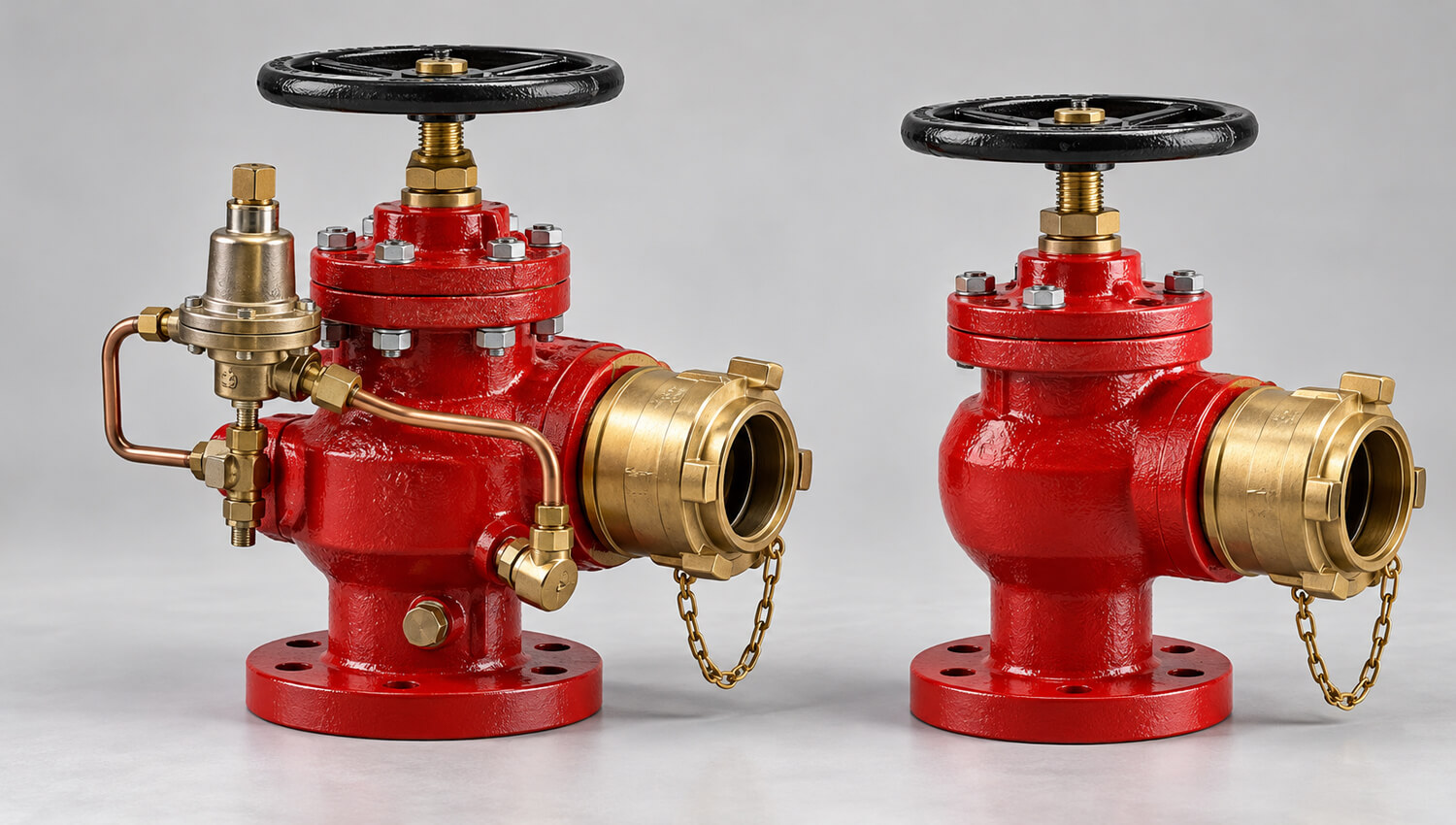
Pressure reducing landing valves control the water pressure delivered from a fire riser to a firefighting hose. Unlike standard landing valves, which mainly open and close the water supply, pressure-reducing models use a regulating mechanism to manage outlet pressure. They’re especially useful where high supply pressure could exceed the safe operating limits of firefighting equipment.
For buyers, the difference matters. The wrong valve can create pressure problems, complicate commissioning, or prevent a fire protection system from meeting its design requirements.
Understanding the Working Principle
A pressure-reducing landing valve typically contains an internal mechanism designed to limit or regulate downstream pressure.
Depending on the valve design, this mechanism may use a spring, diaphragm, piston, or other control arrangement.
Here’s how a typical pressure-reducing function works:
- Water enters the valve from the fire riser.
- The regulating mechanism responds to the pressure conditions.
- The valve changes its internal opening or restriction.
- Water passes through the outlet at the resulting controlled pressure.
- The firefighter connects a compatible hose and operates the outlet.
However, not every valve sold as a pressure-reducing model works in the same way.
Some devices regulate both static and flowing pressure. Others restrict pressure mainly under flowing conditions. These are different functions, and they shouldn’t be treated as equal.
For example, a simple pressure-restricting device may lower pressure during water flow without adequately controlling downstream static pressure.
Buyers should therefore request the manufacturer’s pressure-versus-flow performance data.
Why This Matters for Fire Protection Projects
Water pressure can vary significantly between floors in tall buildings.
Lower floors may experience greater static pressure due to the height of the water column.
A correctly selected pressure-regulating device helps manage these differences.
Still, pressure reduction must never come at the expense of required firefighting flow.
The valve must deliver the design pressure and flow together.
For overseas distributors and project contractors, the practical goal is clear: choose a valve that matches the hydraulic design, applicable standards, and actual operating conditions.
What Are Non-Pressure Reducing Landing Valves?
Non-pressure reducing landing valves are conventional fire hose outlet valves without an integrated pressure-regulating function.
Their main purpose is to provide a connection between the fire riser and the firefighting hose.
When the valve opens, water flows through the outlet. The available pressure depends on the upstream system pressure, the flow rate, and the pressure losses through the valve and connected equipment.
These valves are widely used in fire protection installations where pressure regulation is unnecessary or handled elsewhere.
Basic Design and Operation
A conventional landing valve commonly includes a valve body, operating handwheel, stem, closure assembly, inlet connection, and hose outlet.
The internal closure mechanism allows firefighters to open or shut the water supply.
Common configurations include:
- Oblique-pattern landing valves
- Straight-pattern landing valves
- Right-angle landing valves
- Flanged or threaded inlet designs
- Various regional fire hose outlet connections
The valve’s main function is isolation and water delivery.
Although pressure naturally drops as water passes through a flowing valve, this doesn’t make it a pressure-reducing device.
A conventional valve isn’t designed to maintain a specified downstream pressure automatically.
Why Contractors Choose Standard Landing Valves
Standard landing valves can offer several practical advantages.
First, their construction is generally simpler. This may make them easier to inspect and maintain.
Second, they often cost less than pressure-regulating versions with similar body materials and connection requirements.
Third, they work well in systems where the pump, zoning arrangement, and pipework already provide suitable pressures.
For example, a properly designed low-rise commercial building may not require pressure regulation at individual hose outlets.
Installing a pressure-reducing model in such a system could add cost and unwanted pressure loss.
Yet a standard landing valve must never be selected simply because it’s cheaper.
The designer must first confirm that both minimum and maximum operating pressures remain acceptable.
For B2B buyers, the most useful purchasing documents include the valve’s pressure rating, dimensional drawing, connection specification, and test records.
These details help ensure that the valve fits the approved fire protection design.
Pressure Reducing vs Non-Pressure Reducing Landing Valves
The main difference between the two valve types is pressure management.
A pressure-reducing model has a regulating function. A conventional model primarily controls water flow through manual opening and closing.
The following seven differences are important when comparing fire landing valves for an international project.
Technical Comparison Table
| Feature | Pressure-Reducing Type | Non-Pressure-Reducing Type |
|---|---|---|
| Main function | Controls outlet pressure within its designed operating range | Opens or closes the water supply |
| Internal mechanism | Includes a pressure-regulating mechanism | Uses a conventional valve closure |
| Pressure control | Depends on design; may regulate static and flowing pressure | No automatic downstream pressure regulation |
| Typical application | High-pressure risers and selected building zones | Systems with already suitable outlet pressure |
| Flow performance | Must be checked at the specified inlet pressure and flow | Depends on system pressure and valve loss |
| Installation and setup | May require pressure adjustment and additional commissioning | Usually simpler to commission |
| Cost and maintenance | Often higher cost and more specialized maintenance | Often lower cost and simpler maintenance |
The Seven Differences Buyers Should Evaluate
Pressure control: A regulated valve is selected to manage downstream pressure. A standard valve doesn’t perform that task automatically.
Operating mechanism: Pressure-reducing designs contain additional parts or control features. Conventional designs primarily use a manual closure assembly.
Suitable system conditions: Regulated models may be needed where inlet pressure is too high. Standard models suit systems with acceptable pressure throughout their operating range.
Hydraulic performance: A pressure-reducing device must be checked against its pressure-flow curve. The outlet pressure can change as demand changes.
Commissioning: Adjustable pressure-regulating devices may need setting and verification under actual flow conditions.
Maintenance: Regulating mechanisms require particular attention during inspections and periodic performance tests.
Purchase cost: Pressure-reducing assemblies generally involve more complex engineering and manufacturing.
However, the cheapest purchase isn’t always the most economical solution.
Incorrect pressure control can lead to redesign, replacement, and repeated commissioning work.
A Practical Selection Example
Consider a multi-story building with significantly different pressure conditions on its lower and upper floors.
The engineering design may identify certain lower-floor hose connections that need pressure regulation.
Other floors may operate safely with conventional landing valves.
In that case, specifying one valve model for every floor may be inappropriate.
The correct arrangement depends on hydraulic calculations, pressure limits, and local fire authority requirements.
For contractors and importers, this is why a floor-by-floor valve schedule can be more useful than a simple quantity list.
It identifies exactly where each type is required and reduces the risk of purchasing unsuitable products.
Why Is Water Pressure Control Important in Firefighting?
Water pressure directly affects firefighting performance. Too little pressure can limit the reach and flow of a hose stream. Too much pressure may create unsafe handling conditions or damage equipment.
A well-designed fire protection system must balance both concerns.
For contractors, this means looking beyond the pump’s rated pressure. The pressure available at each hose connection is what matters during firefighting.
Static Pressure and Residual Pressure Explained
Two pressure measurements are particularly important.
Static pressure is measured when water isn’t flowing through the outlet.
Residual pressure is measured while water flows at a specified rate.
These values can differ significantly.
A pressure-regulating valve must be evaluated under the conditions required by the design. A valve that appears suitable under static conditions may behave differently during high water demand.
For example, a device might deliver acceptable outlet pressure during a low-flow test but produce excessive pressure loss at full demand.
That’s why technical data should include both inlet pressure conditions and outlet performance at defined flow rates.
How Building Height Affects Pressure
In a water-filled vertical pipe, elevation affects static pressure.
As a useful engineering estimate, every 10 meters of water column creates approximately 0.98 bar of hydrostatic pressure difference.
This is a pressure-height relationship, not a complete calculation of firefighting system performance.
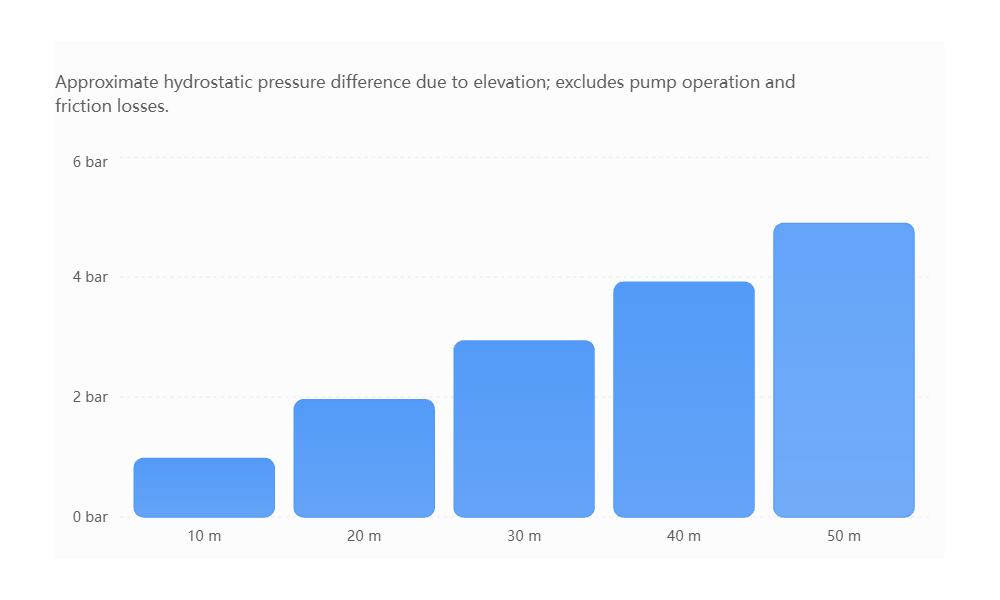
For a high-rise building, the pressure difference between upper and lower floors can become substantial.
This is one reason designers consider pressure zones and regulating devices.
Safety and Hydraulic Performance Must Work Together
The goal isn’t simply to reduce water pressure as much as possible.
Firefighters need adequate pressure to deliver the required hose stream.
According to NFPA’s standpipe design guidance, traditional NFPA 14 Class I design criteria include a minimum residual pressure of 100 psi (6.9 bar) at the hydraulically most remote 2½-inch hose connection.
The same guidance describes pressure limitations that may require pressure-regulating devices.
The applicable edition and local requirements must always be confirmed.
For equipment buyers, pressure control should be treated as a design requirement, not an optional product feature.
Where Should Each Type of Landing Valve Be Used?
The right landing valve depends on building height, water supply conditions, system zoning, and the approved fire protection design.
No single valve type is suitable for every project.
Contractors may even need both categories within the same building.
High-Rise Buildings and Multi-Zone Risers
Tall buildings often present the greatest pressure-management challenges.
Lower-floor outlets may experience high static pressure, while upper-floor outlets need sufficient pressure under firefighting demand.
A pressure-reducing device may be required at selected outlets or as part of the pressure-control arrangement.
However, some buildings use separate pressure zones, dedicated pumps, or other approved methods.
These arrangements can reduce the need for outlet-level regulation.
Therefore, buyers should never assume that every floor of a high-rise building requires the same valve.
Commercial and Industrial Buildings
Conventional landing valves are often suitable for commercial buildings with controlled system pressures.
Typical applications may include offices, warehouses, shopping centers, and industrial facilities.
The building type alone doesn’t determine the correct valve.
An industrial site with a high-pressure firewater network may need pressure regulation, even if its buildings aren’t particularly tall.
Likewise, a large commercial building may use standard landing valves where the hydraulic design keeps pressure within acceptable limits.
Application Selection Matrix
| Application | Potential Valve Selection | Important Design Consideration |
|---|---|---|
| Low-rise commercial building | Conventional valve | Confirm available outlet pressure |
| High-rise lower floors | Pressure-regulating device may be required | Check maximum static pressure |
| High-rise upper floors | Conventional or regulated valve | Confirm required residual pressure |
| Industrial firewater network | Depends on supply pressure | Evaluate full pressure range |
| Multi-zone wet riser | Project-specific | Review zoning and pump arrangements |
| Existing fire riser replacement | Match approved design | Verify current performance and approvals |
This chart is a selection guide, not an engineering approval.
Why Project Documentation Matters
For large projects, purchasing decisions should follow the approved valve schedule.
Each valve location should identify its required type, size, inlet connection, outlet connection, pressure rating, and any regulating setting.
This information is especially important for international orders.
Different markets may use different hose connections and standards.
A valve suitable for one country may not connect to the firefighting equipment used in another.
Before placing a bulk order, confirm that the product specification matches both the design and the local fire service’s connection requirements.
Materials, Construction, and Connection Options
Landing valve construction affects durability, corrosion resistance, pressure performance, and product compatibility.
B2B buyers should review more than the external appearance of the valve.
The body material, seals, internal components, and connections all influence suitability.
Common Valve Body Materials
Copper alloys are widely used in fire landing valves.
Brass and bronze are common choices, although exact alloy specifications vary by product and market.
Brass offers good machinability and can be suitable for many fire protection components.
Bronze grades may provide advantages in particular corrosion environments.
However, no material should be selected without considering the water quality and operating conditions.
Typical Material Considerations
| Component | Common Material Options | Purchasing Consideration |
|---|---|---|
| Valve body | Brass or bronze | Pressure rating and corrosion resistance |
| Operating stem | Brass or stainless steel | Strength and operating durability |
| Handwheel | Metal alloy or suitable approved material | Handling and environmental exposure |
| Sealing components | Compatible elastomers | Water compatibility and service conditions |
| Internal regulating parts | Various metal alloys | Pressure accuracy and durability |
| Outlet coupling | Brass or other approved material | Hose compatibility |
These are general industry material options. They aren’t a specification for any particular manufacturer’s model.
Valve Size and Connection Standards
Common fire hose outlet and landing valve dimensions are often associated with DN40 and DN65 applications.
However, nominal sizes shouldn’t be confused with actual thread dimensions or outlet compatibility.
Depending on the regional market, buyers may encounter British instantaneous connections, threaded hose outlets, and other fire-service coupling systems.
The exact interface must match the equipment used at the destination.
BS 5041-1, for example, covers specified wet-riser landing valves with flanged or screwed inlets and delivery hose connections complying with BS 336. Its scope includes PN15 and PN20 designations.
Important Information to Request
Before approving a sample, request:
- Dimensioned product drawings
- Material specifications
- Rated working pressure
- Approved operating pressure range
- Inlet and outlet connection details
- Flow and pressure-performance data
- Applicable test and certification documents
For pressure-regulating models, also request the adjustment range and the manufacturer’s instructions.
These details help you compare products based on verified performance rather than appearance or catalog descriptions alone.
Standards and Certifications for Fire Landing Valves
Fire protection equipment is subject to different standards across international markets.
For distributors and contractors, compliance is one of the most important parts of supplier evaluation.
A valve may look similar to another product but follow a different construction standard.
The first step is identifying which requirements apply to your project.
British Standards for Landing Valves
BS 5041-1:1987 addresses landing valves for wet risers.
The British Standards Institution identifies it as a current standard and describes its scope as including copper-alloy globe and diaphragm valves for suitable wet-riser applications.
The standard covers specified inlet arrangements, pressure designations, and delivery hose connections.
You can review the official description through BSI’s BS 5041-1 standard page.
BS 9990:2015 provides recommendations for non-automatic firefighting systems in buildings, including wet and dry firefighting mains.
It addresses system design, installation, testing, and maintenance rather than serving as a universal product certification for every valve.
NFPA Requirements for Standpipe Systems
NFPA 14 covers the installation of standpipe and hose systems.
Its requirements should be considered where the project specification or local regulations adopt the NFPA framework.
For example, NFPA design guidance discusses a maximum static pressure of 175 psi (12.1 bar) at hose connections, with pressure-regulating devices required in specified conditions.
Requirements can also vary with hose connection size and system classification.
It’s important to recognize that NFPA standpipe hose valves and British-style landing valves don’t necessarily share identical product standards or connections.
A manufacturer’s claim of compliance with one standard doesn’t automatically establish compliance with another.
Compliance Checklist for International Buyers
| Document or Requirement | What You Should Verify |
|---|---|
| Product standard | Exact number, title, and edition |
| Test report | Product model and tests performed |
| Third-party certificate | Issuer, scope, validity, and model coverage |
| Working pressure | Matches maximum expected inlet pressure |
| Flow test data | Meets required design conditions |
| Connection standard | Compatible with local hose equipment |
| Material documentation | Matches purchasing specifications |
| Installation instructions | Suitable for the proposed application |
Certification is not simply a logo printed on a product brochure.
A reliable supplier should identify exactly which models have been tested or approved.
For overseas buyers, this reduces problems during inspection, installation, and project acceptance.
How to Select the Right Fire Landing Valve for Your Project
Choosing a landing valve starts with the fire protection system design.
The required valve isn’t determined by price, appearance, or a supplier’s general recommendation.
It must meet the pressure, flow, connection, and compliance requirements of the project.
Start With the Hydraulic Design
Ask the project engineer for the operating conditions at each hose connection.
The most important values include maximum static inlet pressure, minimum available flowing pressure, and required discharge flow.
The pressure range matters because the system won’t always operate under the same conditions.
Pump operation, flow demand, and supply variations can change the conditions experienced by the valve.
For regulating models, you’ll need to confirm performance across the expected range, not only at one pressure point.
Follow a Practical Selection Process
Review the fire protection designConfirm flow, pressure, location, and applicable standard
Compare minimum and maximum pressureIdentify any outlet requiring regulation
Select an approved valve configurationVerify regulating performance, size, and connections
Review documents and obtain engineering approvalConfirm the model before procurement
Order, inspect, and commissionVerify installed pressure and flow performance
Questions That Help Prevent Wrong Selection
Can the valve operate safely at the highest expected supply pressure?
Will it deliver the required water flow?
Does the pressure-reducing model regulate static pressure, flowing pressure, or both?
Is the outlet compatible with the firefighting hose connection?
Does the manufacturer provide suitable testing documentation?
These questions can prevent expensive mistakes.
A valve’s pressure rating alone doesn’t prove that it can deliver the required flow.
Likewise, a wide adjustment range doesn’t guarantee stable pressure throughout every operating condition.
Request Technical Data Before Ordering
If you’re sourcing valves for a tender or distribution project, request the product datasheet and pressure-flow performance information before comparing prices.
Manufacturers should be able to explain their available configurations and identify any application limits.
Final selection should remain subject to the approved hydraulic design and local authority requirements.
Testing and Quality Control Before Shipment
Quality control is essential when purchasing valves for a fire protection system.
A landing valve may remain unused for long periods. When an emergency occurs, it must operate as intended.
This creates an important responsibility for manufacturers, distributors, and project contractors.
A product’s external finish alone cannot demonstrate reliability.
Hydrostatic Pressure Testing
Hydrostatic testing helps evaluate the pressure-containing integrity of a valve.
During testing, the valve is subjected to water pressure under controlled conditions.
The test can help identify leakage or structural problems.
The required test pressure, duration, and acceptance criteria must follow the applicable product standard or approved test procedure.
Buyers shouldn’t assume that every landing valve uses the same test pressure.
For instance, a valve’s nominal pressure rating and its manufacturing test pressure are different specifications.
Both should be clearly documented.
Seat Leakage and Operating Tests
Seat leakage testing checks whether the closure assembly performs as required.
An operating test can also help identify problems with the handwheel, stem, and internal moving parts.
For a standard valve, the inspection may focus on opening, closing, sealing, and mechanical operation.
A pressure-regulating model needs additional functional checks.
These may include outlet pressure measurement at specified inlet pressures and flow rates.
A complete test should confirm that the valve’s regulating behavior matches the manufacturer’s published performance.
Pressure-Regulation Performance Verification
Consider a buyer requesting an outlet pressure of 7 bar.
That single number isn’t enough for technical approval.
The manufacturer also needs to know the inlet pressure range and required flow rate.
For example, the order may need to define performance at several inlet pressures rather than one factory setting.
Without those conditions, two products described as delivering 7 bar may behave differently in service.
A useful pressure-regulation test report should identify:
- Valve model and size
- Inlet pressure conditions
- Outlet pressure results
- Flow rates used during testing
- Test equipment and method
- Acceptance criteria
- Test date and identification
These details support traceability and allow project engineers to review the results.
What Buyers Should Expect From a Manufacturer
A capable supplier should have a documented inspection process for critical product characteristics.
For large B2B orders, buyers may also request batch identification, inspection records, and approved sampling plans.
If third-party witnessing or certification is required, it should be agreed upon before manufacturing.
This avoids disputes when the shipment is ready.
A strong quality-control process doesn’t replace correct system design, but it helps ensure that the delivered valve matches the approved specification.
Installation, Inspection, and Maintenance Requirements
Correct installation is just as important as correct valve selection.
Even a properly manufactured landing valve may perform poorly if installed incorrectly.
Contractors should always follow the approved drawings, manufacturer’s instructions, and applicable fire protection standards.
Installation Considerations
Before installing a valve, check the inlet connection, outlet orientation, installation space, and accessibility.
The valve must be positioned where authorized personnel can operate it safely.
Its handwheel should be accessible, and the outlet connection should allow a hose to be attached without obstruction.
If the valve includes a pressure-regulating mechanism, installers should verify whether it requires a specific orientation or adjustment procedure.
The pipework also needs adequate support.
A landing valve shouldn’t be used as a structural support for incorrectly installed piping.
Commissioning and Functional Testing
Commissioning must confirm the installed system’s performance.
For pressure-regulating devices, checking static pressure alone may be insufficient.
Where required, flowing tests should verify that the outlet delivers the specified pressure at the design flow rate.
Testing must be carried out with suitable equipment and controlled discharge arrangements.
The results should be recorded for future inspection and maintenance.
Routine Inspection and Maintenance
Inspection requirements depend on the applicable standard and local regulations.
NFPA 25 addresses inspection, testing, and maintenance of water-based fire protection systems.
Published NFPA materials describe full-flow testing for hose connection pressure-regulating devices at five-year intervals, along with inspections and other required maintenance activities.
The locally adopted edition and authority requirements control the actual maintenance schedule.
Common inspection concerns include damaged handwheels, visible leakage, deteriorated seals, missing outlet caps, and damaged hose connections.
For regulating valves, incorrect adjustment or deterioration of internal components may also affect performance.
Maintenance should be performed by qualified personnel.
Any adjustment must follow the approved design setting and manufacturer’s instructions.
Why Maintenance Documentation Matters
For facility owners, maintenance records establish a history of valve performance.
To distributors, clear instructions and replacement-part information improve after-sales support.
For contractors, commissioning records can make future fault diagnosis easier.
This is particularly valuable in large buildings with many similar-looking valves.
Identification tags, recorded settings, and floor-by-floor schedules help prevent confusion.
Fire protection equipment must work years after installation, not just on the day it passes its first test.
Common Procurement Mistakes and How to Avoid Them
International fire equipment buyers often manage several purchasing risks at once.
They must consider technical approval, budget, delivery, documentation, and compatibility with local installations.
When product specifications are incomplete, even a straightforward order can cause major problems.
Buying Based Only on Price
Lower prices may be attractive, especially on high-volume projects.
However, a quotation should be compared against the complete technical specification.
One supplier may include a particular hose coupling or product test. Another may quote a simpler configuration without those requirements.
The products may not be equivalent.
Before comparing prices, ensure that each quotation covers the same materials, pressure rating, connections, performance, and documentation.
Confusing Pressure Rating With Outlet Pressure
This is a particularly important technical mistake.
A valve rated for 20 bar isn’t necessarily designed to deliver 20 bar at its outlet.
The pressure rating generally describes a defined pressure-containing capability under specified conditions.
A regulating setpoint describes intended downstream performance.
The two measurements serve different purposes.
Buyers should request both values separately.
Ignoring the Outlet Connection
A DN65 valve from one supplier may not connect directly to the local fire service’s hose.
Different countries use different connection systems.
Thread form, coupling profile, and dimensional tolerances must match the project requirements.
A connection mismatch can delay installation and cause replacement costs.
Overlooking Documentation and Approval
Some projects require third-party certificates, specific standards, or witness testing.
If these requirements appear only after production, obtaining approval may become difficult.
Review them during supplier qualification.
Procurement Risk Checklist
| Common Mistake | Possible Consequence | Prevention |
|---|---|---|
| Incorrect regulating range | Unsuitable outlet performance | Review pressure-flow data |
| Wrong hose connection | Installation incompatibility | Verify detailed drawings |
| Missing certification | Project approval delays | Check certificate scope before ordering |
| Unverified valve setting | Commissioning failure | Request documented settings and tests |
| Incorrect material | Reduced suitability for service conditions | Approve material specifications |
| No spare-parts plan | Longer maintenance downtime | Confirm service support |
The best purchasing process starts with a complete specification and clear technical communication.
It doesn’t start with a unit-price comparison.
How to Source Landing Valves From a Manufacturer
Sourcing directly from a fire protection equipment manufacturer can help distributors and contractors coordinate technical requirements with production and quality control.
However, factory-direct purchasing isn’t automatically the right choice for every order.
The supplier must still demonstrate suitable products, technical capability, and consistent quality.
Prepare a Complete RFQ
A useful request for quotation should describe the application and technical requirements.
For a pressure-regulating valve, identify the expected inlet pressure range and required downstream performance.
For both valve types, specify the body material, connection standards, size, and design requirements.
A complete RFQ reduces repeated questions and makes supplier quotations easier to compare.
Landing Valve RFQ Template
| RFQ Field | Information Required |
|---|---|
| Product | Pressure-reducing or conventional landing valve |
| Application | Wet riser, standpipe, or other approved system |
| Size | Required nominal inlet and outlet sizes |
| Inlet connection | Thread or flange specification |
| Hose outlet | Coupling type and regional standard |
| Maximum inlet pressure | Project design value |
| Required outlet pressure | Static and/or flowing conditions |
| Required flow | Design flow rate |
| Materials | Specified body and internal component materials |
| Compliance | Applicable standard and approval requirements |
| Quantity | Total units by model |
| Documentation | Drawings, test reports, certificates |
| Customization | Approved labeling or other OEM requirements |
| Delivery | Required shipping destination and schedule |
Evaluating OEM Requirements
For distributors developing private-label product lines, OEM services may support consistent branding and packaging.
However, technical modifications require special attention.
A change to the valve body, internal mechanism, or pressure-containing components may affect its tested performance or approval status.
Even changes to connections can introduce new compatibility requirements.
Therefore, product customization should follow a documented engineering review.
Buyers should also ask whether customized versions retain the relevant test or certification coverage.
What to Check Before Placing a Bulk Order
Request a sample or approved production drawing where practical.
Confirm all critical dimensions and technical specifications.
Agree on inspection requirements, product identification, packing, and shipment documentation.
For projects with demanding quality requirements, consider a pre-shipment inspection or third-party verification.
You should also clarify how technical questions and replacement-part requests will be handled after delivery.
The real goal is to establish a dependable supply arrangement.
For recurring buyers, consistent technical documentation and manufacturing quality can be more valuable than a small difference in unit price.
A well-prepared quotation request helps the manufacturer provide an accurate offer and reduces misunderstandings throughout the order.
FAQ
What is the main difference between pressure-reducing and non-pressure-reducing landing valves?
A pressure-reducing landing valve includes a mechanism intended to control downstream water pressure. A conventional valve primarily opens and closes the supply. The correct choice depends on the hydraulic design, required flow, pressure limits, and applicable standards.
Are pressure-reducing landing valves necessary in every high-rise building?
No. Their use depends on the building’s water pressure distribution and approved fire protection design. Some buildings use separate pressure zones or other approved arrangements. An engineer must determine which outlets require regulation.
Can a non-pressure-reducing landing valve be installed in a high-pressure system?
Only when the system design confirms that the valve and connected equipment will operate within their approved pressure limits. A conventional valve doesn’t automatically protect the hose outlet against excessive pressure.
Do pressure-reducing landing valves affect water flow?
Yes. Every valve creates some hydraulic resistance, and regulating mechanisms can affect the pressure-flow relationship. The selected model must deliver sufficient water at the required operating conditions. Always review performance data before ordering.
What standards apply to fire landing valves?
Relevant requirements may include BS 5041-1, BS 336, BS 9990, NFPA 14, and local regulations. These documents have different purposes and scopes. The project engineer should identify the applicable standards and required product approvals.
What materials are commonly used for landing valve bodies?
Brass and bronze are common body materials, with specific grades depending on the product design. Material selection should consider pressure, water quality, corrosion exposure, and applicable standards. Buyers should request a clear material specification.
How can buyers verify pressure-reducing valve performance?
Request pressure-flow data, test procedures, and test reports showing inlet and outlet conditions. Where relevant, verify performance at several operating points. The manufacturer should also identify adjustment limits and installation requirements.
Are pressure-reducing valves more expensive than conventional landing valves?
They often cost more because of their additional regulating components and testing requirements. However, prices depend on materials, design, approvals, and quantity. Buyers should compare technically equivalent products rather than unit prices alone.
Can landing valves be customized for overseas distributors?
Depending on the manufacturer’s capabilities and product approvals, customization may include labeling, packaging, or connection options. Technical changes must be evaluated carefully because they can affect pressure performance, compatibility, and certification.
What information should buyers provide when requesting a quotation?
Provide the required valve type, size, connections, material, inlet pressure range, design flow, standards, quantity, and destination. For regulated models, include outlet pressure requirements under defined conditions. Complete information helps suppliers prepare accurate quotations.
Conclusion
Choosing the correct fire landing valve requires more than comparing product appearance or pricing.
The essential difference is pressure control.
Pressure-reducing models are designed to manage downstream pressure. Conventional models primarily provide manual flow control.
Both can serve important roles in correctly designed firefighting systems.
For high-rise buildings and other installations with significant pressure variation, pressure regulation may be necessary.
For systems with suitable outlet pressures, conventional landing valves can provide a simpler solution.
The final choice must reflect hydraulic calculations, required flow, local standards, connection compatibility, and verified product performance.
For overseas importers, fire protection contractors, and distributors, comprehensive technical documentation is essential.