
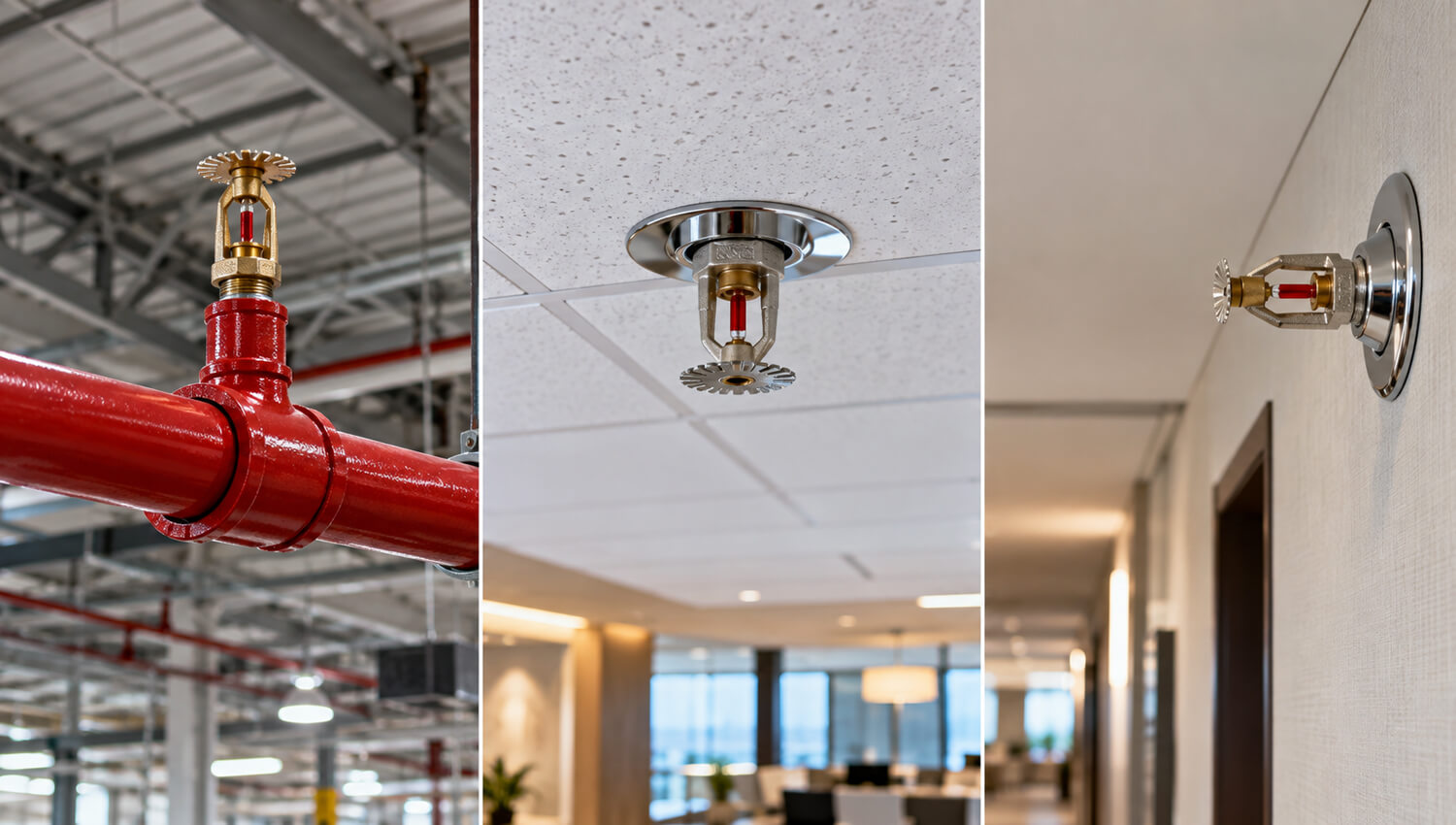
Upright sprinklers point upward and typically protect areas with exposed overhead piping. Pendent sprinklers point downward and are commonly installed below ceilings. Sidewall sprinklers discharge water outward from a wall or suitable vertical mounting surface. Each type has a different deflector design, installation position, and approved coverage pattern. The right choice depends on building layout, fire hazards, hydraulic design, and applicable installation standards.
For fire protection contractors and equipment distributors, choosing the correct sprinkler is more than a purchasing decision. It affects installation cost, system performance, product approval, and long-term maintenance.
A sprinkler that works well in an open warehouse may not suit a hotel corridor. Likewise, a pendent head designed for a finished ceiling cannot simply replace an upright model.
The following table gives you a quick comparison.
| Feature | Upright Sprinkler | Pendent Sprinkler | Sidewall Sprinkler |
|---|---|---|---|
| Installation position | Above piping, pointing upward | Below piping, pointing downward | Typically installed near a ceiling on a wall |
| Water distribution | Deflector directs water outward and downward | Deflector spreads water outward and downward | Primarily directs water outward into the room |
| Common locations | Warehouses, factories, exposed ceilings | Offices, hotels, retail buildings | Corridors, narrow rooms, wall-fed spaces |
| Piping arrangement | Often exposed overhead | Often above a finished ceiling | Often routed within or along walls |
| Visual appearance | Usually visible | Exposed, recessed, or concealed options | Usually visible or recessed |
| Installation limitation | Obstructions and deflector clearance | Ceiling configuration and deflector position | Wall geometry and listed coverage |
| Main selection factor | Exposed structural conditions | Ceiling layout and building use | Room shape and wall-based distribution |
These are common characteristics, not universal installation rules. Actual design limits depend on the specific sprinkler model and its listing.
How Do Fire Sprinkler Heads Work?
Automatic fire sprinklers are designed to release water when heat from a fire reaches a defined activation level.
Most commercial sprinklers use a glass bulb or a fusible-link mechanism. This heat-sensitive element keeps the sprinkler closed during normal conditions.
When the surrounding temperature rises enough, the element operates. The sprinkler opens, and water flows through its internal passage toward a deflector.
The deflector shapes the spray pattern, helping distribute water over the intended area.
Unlike a common movie scene, ordinary automatic sprinkler systems don’t usually release water from every head at once. Individual sprinklers activate when exposed to sufficient heat, although several may operate during a developing fire.
Main Components of an Automatic Sprinkler
- Body or frame: Supports the sprinkler assembly and connects to the piping.
- Thermal element: Responds to heat and releases the sealing assembly.
- Sealing assembly: Prevents water discharge before activation.
- Deflector: Controls the water distribution pattern.
- Threaded inlet: Connects the sprinkler to a compatible pipe fitting.
These components must work together as part of a tested design.
A sprinkler’s orientation is especially important because its deflector is engineered for a specific installation arrangement.
Why Sprinkler Orientation Matters
An upright model generally receives water from below its deflector. A pendent model receives water from above its deflector.
The internal flow path and deflector geometry are designed to produce the intended spray pattern in the specified orientation.
Sidewall sprinklers are different again. Their deflectors typically distribute water outward from a wall, with coverage concentrated in the protected space.
Installing a directional sprinkler in an unapproved position can change its discharge characteristics and prevent compliance with the approved design.
For buyers, the practical lesson is simple: order sprinkler heads according to the approved system design, not only their visible shape or threaded connection.
What Is an Upright Fire Sprinkler?
An upright fire sprinkler is installed with its deflector facing upward. The sprinkler commonly extends above a branch pipe in areas where the piping remains exposed.
When activated, water travels upward through the sprinkler and strikes the deflector. The deflector distributes the discharge outward and downward into the protected area.
Upright sprinklers are widely used in commercial and industrial spaces where exposed ceiling structures are common.
Common Applications
Typical applications include:
- Industrial manufacturing facilities
- Warehouses and storage buildings
- Mechanical equipment rooms
- Commercial buildings with exposed overhead piping
- Selected parking or service areas
However, not every upright model is suitable for every industrial hazard.
For example, storage arrangements and high-piled commodities may require specialized sprinklers with specific discharge characteristics.
Advantages of Upright Sprinklers
Suitable for exposed piping
Upright heads often work well where branch lines are installed below structural members. This can simplify pipe routing in certain building layouts.
Accessible for visual inspection
Because the heads are visible, maintenance teams can more easily notice physical damage, corrosion, or unwanted paint.
Useful in industrial environments
Many industrial buildings have open ceilings and limited decorative requirements. Upright sprinklers fit these conditions well.
Limitations to Consider
Upright sprinklers require careful attention to overhead obstructions.
Beams, ducts, cable trays, and other building components can interfere with water distribution if the sprinkler layout is incorrect.
The position of the deflector relative to the ceiling or roof deck must also follow applicable installation rules.
An upright sprinkler isn’t automatically a heavy-duty warehouse sprinkler. Its listed application, K-factor, and design criteria remain essential.
For distributors, keeping clear model descriptions helps customers avoid confusion between standard spray upright sprinklers and specialized storage protection products.
What Is a Pendent Fire Sprinkler?
A pendent fire sprinkler is installed facing downward, normally below a horizontal pipe connection.
Its deflector sits beneath the sprinkler body and distributes water outward and downward when the heat-sensitive element operates.
Pendent sprinklers are common in buildings with finished ceilings, where appearance and occupant comfort matter alongside fire protection.
They are also used in industrial and commercial applications when the approved piping and ceiling arrangement supports their use.
Common Applications
Pendent sprinklers are frequently found in:
- Office buildings
- Hotels and hospitality facilities
- Shopping centers
- Schools and educational buildings
- Healthcare facilities
- Commercial spaces with suspended ceilings
Their downward orientation makes them a practical choice for many ceiling-mounted systems.
Exposed, Recessed, and Concealed Models
Pendent sprinklers may be available in different visible configurations.
| Configuration | Appearance | Typical Consideration |
|---|---|---|
| Exposed pendent | Sprinkler extends visibly below ceiling | Straightforward access and inspection |
| Recessed pendent | Part of the sprinkler assembly sits within an approved escutcheon arrangement | More integrated ceiling appearance |
| Concealed pendent | Sprinkler is hidden behind a listed cover plate | Discreet architectural finish |
These configurations aren’t automatically interchangeable.
Concealed sprinklers require compatible cover plates and installation components specified by the manufacturer.
The cover plate’s thermal operation is part of the listed assembly. Replacing it with an unapproved decorative cover can affect performance.
Advantages and Limitations
Pendent sprinklers can offer a clean ceiling layout while maintaining practical coverage.
They are especially useful where piping is routed above suspended ceilings.
However, they must be positioned correctly relative to the ceiling surface. Lighting fixtures, air diffusers, and decorative features can create obstruction concerns.
If you’re supplying a commercial construction project, confirm whether the contractor needs exposed, recessed, or concealed pendent models.
A small difference in the purchase order can create a significant installation problem.
What Is a Sidewall Fire Sprinkler?
A sidewall fire sprinkler is designed to distribute water from a location near a wall. Instead of relying on a sprinkler positioned in the middle of a ceiling, it directs discharge outward into the protected space.
Horizontal sidewall sprinklers are usually installed near the ceiling, with the sprinkler body extending horizontally from a wall connection.
Vertical sidewall sprinklers are also available. However, their installation requirements and discharge patterns differ from those of horizontal models.
This distinction matters when selecting replacement heads or preparing a purchase order.
Where Are Sidewall Sprinklers Commonly Used?
Sidewall sprinklers may be suitable for:
- Hotel corridors and selected guest rooms
- Offices with restricted ceiling access
- Narrow commercial rooms
- Certain healthcare and educational spaces
- Buildings where ceiling piping is difficult to install
Their wall-based arrangement can simplify piping in some projects. It can also reduce visible overhead pipework.
Standard vs Extended Coverage Sidewall Sprinklers
Some sidewall sprinklers provide standard coverage, while others have extended-coverage listings.
For example, Tyco describes certain extended-coverage horizontal sidewall models with listed coverage dimensions reaching 16 × 24 feet (approximately 4.9 × 7.3 meters).
Those dimensions apply to specified products and design conditions. They aren’t general limits for all sidewall sprinklers.
Advantages and Limitations
A major benefit of sidewall sprinklers is installation flexibility.
They can be useful where overhead piping would interfere with architectural features or construction work.
However, water distribution may be affected by deep rooms, unusual ceiling shapes, or obstructions.
Sidewall sprinklers aren’t automatically suitable for large warehouses or high-hazard industrial areas.
The selected model must be listed for the intended use. Its installation position, coverage dimensions, and hydraulic requirements must match the approved design.
For importers, specify whether you need horizontal or vertical sidewall sprinklers. Also confirm standard or extended coverage before placing an order.
The 7 Essential Differences Between Fire Sprinkler Types
Choosing between upright, pendent, and sidewall sprinklers requires more than comparing product photographs.
The following seven differences influence system design, installation, and procurement.
Installation Orientation
Upright sprinklers face upward, while pendent sprinklers face downward.
Horizontal sidewall models extend from a wall and discharge across the room.
Each orientation uses a specially designed deflector. You should never assume that one model can replace another simply because their threads match.
Water Distribution Pattern
Upright and pendent standard spray sprinklers generally distribute water outward and downward.
Sidewall models direct discharge mainly away from the mounting wall.
The precise distribution depends on the product design and listing.
Coverage Area
There is no single coverage area for each sprinkler orientation.
Coverage depends on the sprinkler listing, occupancy hazard, ceiling conditions, and design rules.
A standard-coverage pendent sprinkler may protect a different allowable area from an extended-coverage sidewall model.
Piping and Installation Requirements
Upright models often suit exposed piping.
Pendent models work well with overhead piping and finished ceilings.
Sidewall models can support wall-based branch piping.
Still, the final arrangement must satisfy the approved system layout.
Obstruction Sensitivity
All three types require suitable clearance around the water discharge pattern.
Beams, ducts, lighting, and equipment may block water distribution.
Obstruction rules vary with the sprinkler design and installation conditions.
Architectural Appearance
Pendent sprinklers offer many ceiling-integrated options.
Sidewall sprinklers may reduce the need for visible ceiling heads in some spaces.
Upright models are generally more visible and are common in functional industrial settings.
Inspection and Replacement
Maintenance teams must inspect sprinkler heads for damage, corrosion, loading, and unauthorized modifications.
Replacement models need to match the applicable technical requirements.
A sprinkler’s appearance alone doesn’t establish interchangeability.
| Selection Priority | Often Considered First | Important Qualification |
|---|---|---|
| Exposed industrial ceiling | Upright | Confirm hazard and obstruction requirements |
| Finished commercial ceiling | Pendent | Confirm ceiling and escutcheon details |
| Wall-based pipe arrangement | Sidewall | Confirm room geometry and listing |
| Discreet architectural finish | Recessed or concealed pendent | Use approved assemblies |
| Extended room coverage | Listed extended-coverage model | Verify maximum dimensions and hydraulics |
These differences provide a useful starting point, but the project’s fire protection designer must make the final technical selection.
Understanding Sprinkler K-Factor, Temperature Rating, and Response Time
Sprinkler orientation is only one part of product selection.
Professional buyers must also understand the technical specifications that determine water flow, thermal operation, and application suitability.
Sprinkler K-Factor and Water Flow
The K-factor describes the relationship between water pressure and discharge flow.
For conventional sprinkler calculations:
\[ Q=K\sqrt{P} \]
Where:
- Q: Water flow rate
- K: Sprinkler discharge coefficient
- P: Water pressure at the sprinkler
Units must remain consistent. In US customary units, flow is measured in gallons per minute, pressure in psi, and the K-factor is expressed accordingly.
Consider a K5.6 sprinkler operating at 25 psi.
Its theoretical discharge flow is:
\[ Q=5.6\sqrt{25}=28\text{ gpm} \]
This is approximately 106 liters per minute.
That doesn’t mean 25 psi is the correct design pressure for every K5.6 sprinkler. The required pressure must come from the hydraulic calculation and applicable listing.
Common K-Factors
| Nominal K-Factor (US) | Typical Product Context |
|---|---|
| K2.8 | Selected small-orifice and special applications |
| K5.6 | Common standard spray commercial sprinklers |
| K8.0 | Selected commercial and industrial applications |
| K11.2 | Selected higher-flow or extended-coverage applications |
| K14.0 and above | Specialized industrial, storage, or higher-demand applications |
Model availability varies. As one example, Tyco’s commercial sprinkler lines include several orientations and K-factor choices.
Temperature Ratings and Thermal Response
Fire sprinklers operate at specified temperature ratings.
Common nominal ratings include:
| Temperature Rating | Approximate Celsius Equivalent |
|---|---|
| 135°F | 57°C |
| 155°F | 68°C |
| 175°F | 79°C |
| 200°F | 93°C |
| 286°F | 141°C |
Other temperature ratings are available.
A sprinkler’s rating must be suitable for the expected ambient temperature and applicable installation requirements.
Response classification is another important factor. Quick-response and standard-response sprinklers have different thermal sensitivity characteristics.
A quick-response sprinkler isn’t automatically acceptable as a replacement for a standard-response model. System design and listing requirements govern substitution.
For distributors and contractors: Request a technical datasheet that identifies K-factor, temperature rating, response classification, orientation, thread type, and approval status before confirming a bulk order.
Which Sprinkler Is Best for Different Building Applications?
Different buildings present different fire risks, ceiling structures, and piping constraints.
That is why sprinkler selection should begin with the actual application.
Warehouses and Distribution Centers
Warehouses often have exposed piping, high ceilings, and complex storage arrangements.
Upright sprinklers may suit certain exposed-piping layouts.
However, storage buildings can require specialized protection strategies. Commodity classification, rack height, storage configuration, and ceiling height all influence the design.
A standard upright sprinkler isn’t automatically suitable for high-piled storage.
Hotels and Hospitality Buildings
Hotels often prioritize a clean interior appearance.
Pendent sprinklers may be installed in guest rooms, conference facilities, and other finished-ceiling areas.
Sidewall sprinklers can also be suitable for specific corridors and rooms.
The choice depends on the building layout and applicable listing.
Manufacturing Facilities
Manufacturing buildings may contain machinery, exposed structural elements, and elevated ambient temperatures.
Upright sprinklers are frequently considered for exposed pipe arrangements.
However, the fire hazard classification determines the required protection.
A facility handling combustible materials may need a different sprinkler design from a general assembly workshop.
Office Buildings and Shopping Centers
Pendent sprinklers are common in finished commercial interiors.
Recessed or concealed versions can help maintain the planned architectural appearance.
Where approved, sidewall models may offer useful alternatives for restricted ceiling spaces.
Mechanical Rooms and Service Areas
Equipment rooms often have many pipes, ducts, and cable trays.
The sprinkler designer must evaluate possible obstructions before determining head locations.
An upright arrangement may be convenient, but convenience alone isn’t enough.
| Building Application | Commonly Considered Type | Main Design Concern |
|---|---|---|
| Warehouse | Upright or specialized storage sprinkler | Storage hazard and ceiling configuration |
| Hotel guest room | Pendent or sidewall | Listed coverage and appearance |
| Office | Pendent | Ceiling layout and obstructions |
| Corridor | Sidewall or pendent | Room geometry and discharge pattern |
| Factory | Upright or pendent | Process hazards and structural features |
| Retail store | Pendent | Ceiling and fixture arrangement |
Use this chart for early product planning, not as a substitute for a complete fire protection design.
Fire Sprinkler Installation Standards and Common Mistakes
Even a correctly manufactured sprinkler can perform poorly when installed outside its approved conditions.
International buyers should identify the required technical standards before purchasing.
NFPA 13 and Other Applicable Standards
In the United States, NFPA 13 – Standard for the Installation of Sprinkler Systems is a primary reference for sprinkler system design and installation.
The 2025 edition addresses design, installation, and acceptance testing. Projects must follow the edition adopted by their jurisdiction, including applicable amendments.
Other markets may use European or local requirements.
Relevant product standards can include UL 199 and EN 12259-1. These address sprinkler product testing and performance rather than replacing system installation rules.
Common Installation Mistakes
Using the wrong orientation
An upright sprinkler should not be installed downward unless its specific listing explicitly permits that arrangement.
Ignoring deflector location
The distance between a sprinkler deflector and the ceiling or other surfaces affects discharge distribution.
Overlooking obstructions
Ductwork, beams, lighting fixtures, and storage items may interfere with the sprinkler spray.
Selecting an incorrect temperature rating
A sprinkler installed near heat-producing equipment may require special consideration.
Using incompatible accessories
Escutcheons, cover plates, guards, and shields must match the approved configuration.
What Should Installers Verify?
Before installation, contractors should review:
- Approved sprinkler layout and hydraulic calculations
- Applicable product listing and technical datasheet
- Correct orientation, model, and temperature rating
- Required deflector position and spacing
- Potential discharge obstructions
- Approved accessories and installation tools
- Local authority requirements
Sprinklers should be handled carefully during transport and installation.
Never paint, bend, or modify a sprinkler head. Damaged or contaminated sprinklers must be assessed and replaced under the applicable requirements.
Installation and acceptance should be completed by qualified personnel using the approved design and manufacturer instructions.
How to Choose a Reliable Fire Sprinkler Manufacturer
For international distributors, selecting a fire sprinkler supplier involves much more than comparing unit prices.
The supplier must provide products that meet the technical requirements of your target market.
Product consistency, traceability, documentation, and dependable communication are important parts of that decision.
Verify Product Certifications
Ask suppliers to provide the relevant certification details for each sprinkler model.
Depending on the market, buyers may require:
- UL Listing
- FM Approval
- LPCB Approval
- Compliance with applicable EN product standards
- Other approvals required by the destination market
Certification must be verified for the exact model and configuration.
A factory-level quality management certificate doesn’t automatically establish that every sprinkler model is approved for fire protection use.
You can review the scope of sprinkler product testing through UL Solutions’ sprinkler testing and certification information.
Review Manufacturing and Quality Control
A supplier’s quality management process should address critical sprinkler characteristics.
Relevant inspection and control activities may include:
| Quality Control Area | What Buyers Should Verify |
|---|---|
| Material control | Approved material specifications and traceability |
| Dimensional inspection | Threads, orifice dimensions, and critical geometry |
| Assembly control | Approved thermal elements and sealing components |
| Leakage testing | Test procedures and acceptance criteria |
| Water distribution | Applicable type-test evidence |
| Thermal performance | Approved response and operating characteristics |
| Surface finish | Corrosion-resistance requirements |
| Batch identification | Traceability to production records |
Not every test is performed on every finished sprinkler. Some are type tests, while others are production inspections or sample-based checks.
Request the manufacturer’s documented inspection plan rather than assuming that all products receive identical testing.
Evaluate Supply Capabilities
A dependable supplier should communicate clearly about model availability, approved specifications, packing, order quantities, and delivery arrangements.
For OEM or private-label inquiries, branding arrangements must not compromise product certification, markings, or traceability.
Different markings or private-label versions may require separate certification review.
Buyers should also establish a clear process for technical questions and product nonconformities.
Fire Sprinkler Procurement Checklist for Buyers
Purchasing fire sprinklers for international projects involves both engineering and commercial requirements.
A complete request for quotation helps avoid delays, incorrect substitutions, and disputes over specifications.
Identify Your Technical Requirements
Start with the approved sprinkler schedule or bill of materials.
Each line item should identify the sprinkler type, model, and required technical details.
A general description such as “fire sprinkler head, brass, 1/2 inch” is rarely sufficient for a construction project.
Include the required orientation, response type, temperature rating, K-factor, thread specification, finish, and certification.
Compare Technical Documents Before Prices
Two products may look similar but carry different listings or installation conditions.
Request official datasheets and approval references.
Where substitutions are proposed, obtain the required engineering and authority approvals before purchasing.
Confirm Packing and Traceability
Export packing should protect delicate sprinkler components from damage.
Ask about protective caps, individual packaging, carton identification, and batch marking.
Also confirm how the supplier identifies different temperature ratings and sprinkler models.
Clear packaging reduces sorting mistakes when multiple sprinkler configurations arrive at one project site.
Example RFQ Checklist
| RFQ Item | Information to Provide |
|---|---|
| Sprinkler type | Upright, pendent, or sidewall |
| Model or SIN | Exact listed model, if specified |
| K-factor | Required discharge coefficient |
| Response | Quick or standard |
| Temperature rating | Specified activation temperature |
| Thread connection | NPT, ISO, or other approved connection |
| Finish | Brass, chrome, white, or specified finish |
| Certification | Required listing or approval |
| Quantity | Units per model and temperature rating |
| Destination | Country and delivery location |
| Documentation | Datasheets, certificates, inspection records |
| Commercial terms | Packing, lead time, payment, and Incoterms |
Plan for Long-Term Supply
For distributors, repeat orders are often as important as the first shipment.
Check whether the manufacturer can maintain consistent approved product configurations.
Also review how the supplier handles design changes, discontinued products, and replacement parts.
For large construction projects, request samples and documentation early in the procurement process.
Engineering approval should come before bulk purchasing.
A well-prepared RFQ helps the supplier quote accurately. It also reduces the risk of receiving products that cannot be installed or accepted by the project’s inspection authority.
FAQ
Can upright sprinklers be installed in a pendent position?
Generally, no. An upright sprinkler must be installed in its listed orientation unless the specific product approval allows another position. Its deflector is designed for defined discharge conditions. Installing it upside down without approval can affect water distribution and violate installation requirements.
Which sprinkler type is better for warehouses?
Upright sprinklers are common in warehouses with exposed piping. However, warehouse protection depends on storage height, commodity type, ceiling configuration, and sprinkler system design. Some facilities require specialized storage sprinklers, including approved ESFR models, rather than ordinary standard spray sprinklers.
Are sidewall sprinklers suitable for large rooms?
Some extended-coverage sidewall models can protect relatively large areas under specified conditions. However, allowable room dimensions depend on the model listing, hydraulic calculations, ceiling configuration, and hazard classification. Sidewall sprinklers should not be selected using room dimensions alone.
What is the difference between quick-response and standard-response sprinklers?
Quick-response sprinklers have different thermal sensitivity characteristics from standard-response models. Their response classifications are established through testing. Actual activation also depends on fire conditions and installation. One response type cannot automatically replace the other without confirming the system design and product approval.
What K-factor should I choose for a commercial sprinkler system?
The required K-factor depends on water supply, hydraulic calculations, hazard classification, and the sprinkler’s listed application. K5.6 is common in many commercial systems, but other values may be required. Always follow the approved sprinkler schedule and engineering calculations.
Can pendent and sidewall sprinklers be used in the same building?
Yes. A building may use different sprinkler orientations in different rooms or areas. Each sprinkler must be suitable for its location and meet the applicable design requirements. The entire system must also satisfy hydraulic and installation criteria.
What certifications should overseas buyers request from a sprinkler manufacturer?
Buyers should request the approvals required in their destination market, such as UL Listing, FM Approval, or applicable European product certification. Verify the exact model and approved configuration. A general factory certificate or an unrelated product certificate is not sufficient evidence.
What information should I provide when ordering sprinkler heads in bulk?
Provide the sprinkler orientation, model, K-factor, response classification, temperature rating, thread type, finish, required approval, and quantity. Include the destination country and project requirements. A technical schedule or approved bill of materials will help prevent specification errors.
Conclusion: Choose the Right Sprinkler for Reliable Fire Protection
Upright, pendent, and sidewall sprinklers serve different installation needs.
Upright models commonly suit exposed overhead piping. Pendent models work well in many finished-ceiling applications. Sidewall models offer another option for suitable wall-based layouts.
However, installation orientation alone doesn’t determine the right sprinkler.
Buyers must also consider discharge characteristics, K-factor, response classification, temperature rating, obstructions, hydraulic calculations, and certification.
For fire protection distributors and contractors, accurate specifications are the foundation of successful procurement.
Working with a manufacturer that provides clear technical documentation and traceable products can help reduce purchasing mistakes and project delays.