A wet alarm valve serves sprinkler pipes filled with pressurized water. A dry pipe valve holds water back from pipes containing pressurized air or nitrogen. A deluge valve releases water into a network of open nozzles when its release system activates. The right choice depends on freezing risk, fire hazard, water delivery needs, and project standards.
For fire protection contractors and international buyers, choosing the right equipment is a major decision. A wrong specification may delay installation, increase maintenance costs, or affect system performance.
Each valve serves a different purpose. You can’t simply replace one with another because the pipe size looks similar.
A heated commercial building may need a simple wet system. An unheated warehouse may need dry piping. A high-hazard industrial area may require a deluge arrangement.
Beyond selecting the valve type, buyers must examine pressure ratings, connections, trim assemblies, and approval documents.
This guide explains how these valves work, where they are used, and what you should check before ordering from a manufacturer.
Wet Alarm Valve: Function, Components, and Benefits
A wet alarm valve is an important part of many automatic fire sprinkler systems. It helps control water flow direction and provides an alarm signal when water flows through the system.
In a typical wet pipe installation, the pipes above the valve remain filled with pressurized water. When heat activates a sprinkler, water flows through that sprinkler to control or suppress the fire.
The alarm check valve responds to this flow. Its internal clapper opens as water moves toward the sprinkler network. Depending on the valve arrangement, water also enters the alarm line and activates alarm devices.
Main Components of a Wet Alarm Valve Assembly
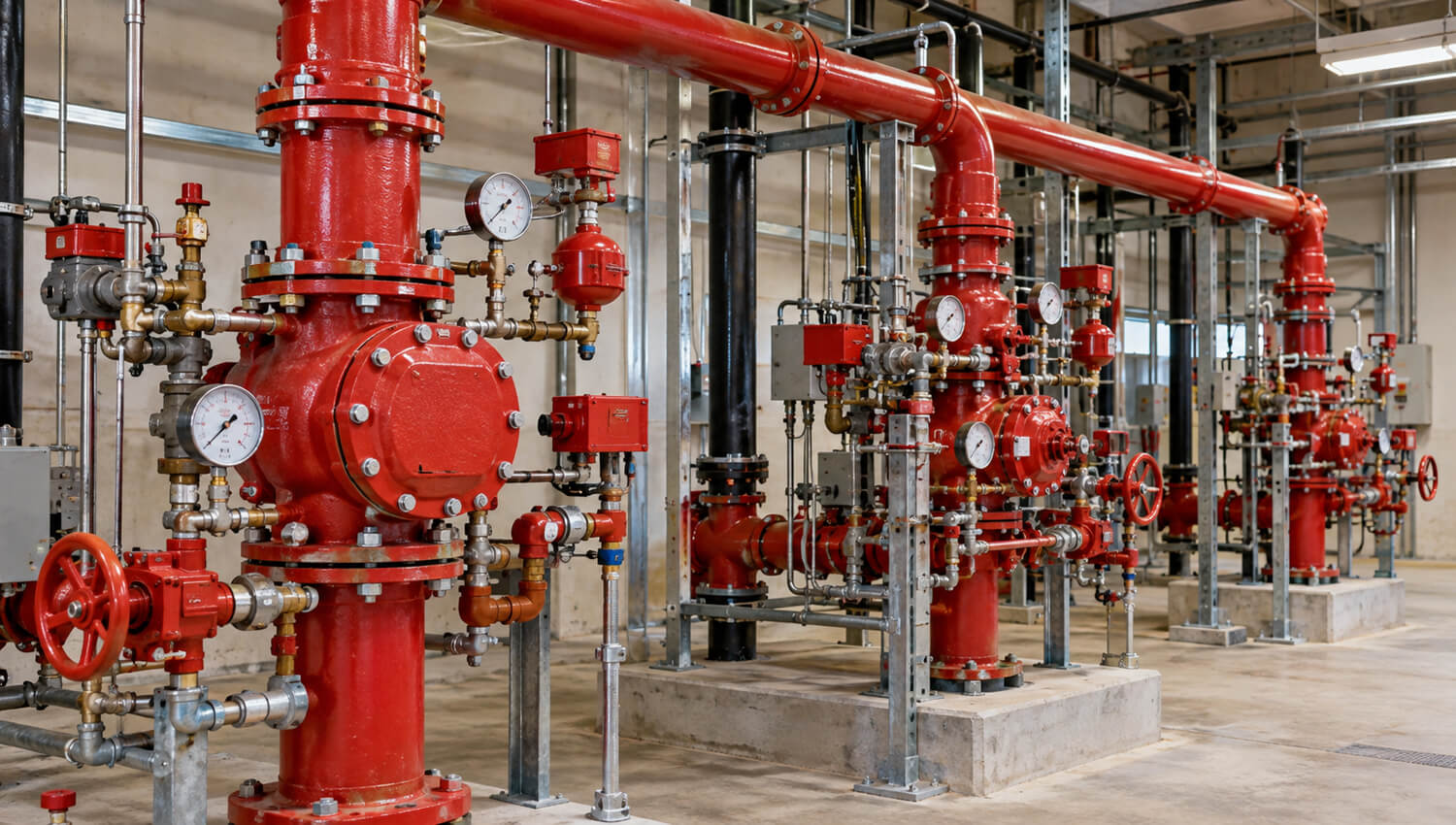
A typical assembly may include:
- Valve body: Houses the internal sealing and flow control parts.
- Clapper assembly: Allows water to flow toward the sprinkler system.
- Water motor gong: Produces a mechanical alarm when sufficient water flows.
- Pressure switch: Sends an electrical signal to a fire alarm system.
- Retard chamber: Helps reduce unwanted alarms caused by short pressure changes in systems where it is required.
- Pressure gauges: Show the water pressure on each side of the valve.
- Drain and test connections: Support inspection and maintenance.
Not every installation uses exactly the same trim arrangement. The manufacturer’s approved design determines the required components.
Why Buyers Choose Wet Pipe Systems
One major benefit is simple operation. Water is already available inside the sprinkler piping, so there is no need to remove air before water reaches an open sprinkler.
Wet systems also generally require fewer supporting devices than dry pipe or deluge installations.
For a commercial building with reliable heating, this simplicity can reduce equipment and maintenance costs.
However, wet piping must be protected from freezing. Water-filled pipes can freeze, expand, and break in cold conditions.
For buyers, a complete valve assembly is often more useful than a bare valve. It can simplify purchasing, although the delivered components must match the approved project design.
Wet Alarm Valve vs Dry Pipe Valve vs Deluge Valve
The main differences between these valves are their normal operating conditions, activation methods, and intended applications.
All three help control water in fire protection systems. However, they respond to fire events in different ways.
A wet alarm check valve supports a water-filled network. A dry pipe valve separates pressurized water from a pipe network containing air or nitrogen. A deluge valve opens when its releasing arrangement operates.
The distinction matters because valve selection affects the entire sprinkler system design.
Technical Comparison Table
| Feature | Wet alarm check valve | Dry pipe valve | Deluge valve |
|---|---|---|---|
| Normal pipe condition | Filled with water | Filled with air or nitrogen | Normally without water downstream |
| Sprinkler type | Normally closed | Normally closed | Normally open |
| Activation | Sprinkler opens and water flows | Sprinkler opens, gas pressure drops, valve trips | Detection or release system operates |
| Water delivery | Water already in piping | Additional delay while water fills piping | Water enters open-nozzle network after release |
| Freezing suitability | Requires freeze protection | Suitable for certain freezing environments | Depends on valve, piping, drainage, and system design |
| Typical application | Heated commercial buildings | Unheated buildings and freezing areas | Selected high-hazard facilities |
| Supporting equipment | Alarm trim and waterflow devices | Gas supply, pressure controls, trim | Release controls, detection, trim |
| System complexity | Generally lower | Moderate to high | High |
| Routine maintenance | Generally simpler | Requires gas and trip-system checks | Requires detection and release-system checks |
| Main buyer priority | Reliability and simplicity | Freeze protection | Rapid water application over a hazard area |
Seven Critical Differences
01 Pipe condition
Wet systems contain water; dry systems contain pressurized gas; deluge systems use normally open outlets.
02 Activation
Wet and dry systems depend on sprinkler operation. Deluge systems use a separate release arrangement.
03 Water delivery
Wet piping avoids the air-clearing delay found in dry systems.
04 Freezing risk
Dry systems are frequently selected where wet piping cannot be protected from freezing.
05 Hazard coverage
Deluge systems can discharge through all connected open outlets when activated.
06 System cost
Dry and deluge installations commonly require more supporting equipment.
07 Maintenance
Dry and deluge systems need additional checks for their operating and release equipment.
Which System Is Better?
There is no single answer.
For heated buildings with ordinary commercial hazards, wet systems are often the first option to evaluate.
Where freezing is a concern, dry systems may be more suitable. For certain high-hazard industrial areas, deluge arrangements may offer the required protection.
The correct choice must come from the fire protection design, not price alone.
How a Dry Pipe Valve Works
A dry pipe valve is designed for sprinkler networks that must not remain full of water.
This is especially useful in buildings where temperatures may fall below freezing. Examples include unheated warehouses, loading areas, and some parking structures.
Unlike a wet system, a dry system contains pressurized air or nitrogen in its sprinkler piping.
The dry pipe valve keeps the water supply separated from this gas-filled network.
The Dry Pipe Valve Operating Sequence
Normal condition
Water held below valve; air or nitrogen above
Fire heats a sprinkler
The heat-sensitive element opens
Gas pressure drops
The valve trips at its designed pressure relationship
Water enters the piping
Water travels to the opened sprinkler and discharges
This sequence explains why dry systems normally have a longer water delivery time than wet systems.
Before discharge begins, gas must escape and water must travel through the pipe network.
Important Dry System Components
A complete dry system may need a compressor or nitrogen supply, pressure maintenance device, pressure switches, and low-point drains.
Some designs also include quick-opening devices to improve water delivery performance.
The required components depend on system size, layout, approval conditions, and applicable standards.
What Buyers Should Consider
Dry valves are not automatically better simply because they avoid water-filled pipes.
They introduce other maintenance requirements. Gas pressure must remain correct, and condensate must be drained where necessary.
Any remaining water in the piping can freeze.
For an international purchasing project, ask the manufacturer for operating pressure limits, gas-to-water pressure requirements, reset instructions, and complete trim drawings.
These documents help contractors understand the equipment before it reaches the construction site.
How a Deluge Valve Works
A deluge valve is used in fire protection systems where water must be released across a selected hazard area.
In a typical deluge sprinkler system, the discharge outlets are open. They do not need individual heat-sensitive elements to open.
Instead, a separate detection or manual release arrangement operates the main valve.
Once released, the valve allows water to enter the distribution piping. Water then discharges from the connected open outlets.
This makes deluge systems different from ordinary wet and dry sprinkler installations.
Deluge Valve Activation Methods
Depending on the approved design, a deluge system may use:
- Electric release through a detection and control system.
- Pneumatic release through a pilot network.
- Hydraulic release through an approved pilot arrangement.
- Manual emergency release.
The available release methods depend on the valve model and the manufacturer’s listed configurations.
For example, Viking Group describes its Model F-1 as a diaphragm-operated valve. Water pressure holds it closed through a priming chamber. When the release system reduces that pressure, the main valve opens.
Where Deluge Systems Are Used
Common applications include selected transformer protection systems, chemical processing areas, and industrial operations with fast-developing fire hazards.
However, not every industrial facility needs a deluge system.
The decision depends on the hazard analysis, available water supply, applicable design standard, and required discharge pattern.
Why Valve and Release Compatibility Matters
A deluge valve is only one part of the system.
You must also consider detectors, releasing panels, solenoid valves, emergency release devices, and water supply capacity.
A valve that fits the pipeline may still be unsuitable for the required detection arrangement.
For this reason, procurement teams should request a complete bill of materials and an approved release-system diagram.
These checks help avoid costly changes during installation and commissioning.
Choosing the Right Valve for Different Buildings
The correct fire protection valve depends on the building’s use and environment.
A warehouse, office tower, and industrial processing plant may require very different sprinkler arrangements.
For buyers, the key question is not simply which valve is more advanced. It is which system meets the project’s actual safety and performance requirements.
Application Selection Matrix
| Facility or application | Common starting point | Main consideration |
|---|---|---|
| Heated office building | Wet pipe | Reliable water supply and freeze protection |
| Shopping mall | Wet pipe | Occupancy and sprinkler design |
| Heated hotel | Wet pipe | Building layout and local fire code |
| Unheated warehouse | Dry pipe | Low-temperature operation and water delivery |
| Exposed parking structure | Dry pipe or protected wet arrangement | Local climate and pipe conditions |
| Cold storage facility | Engineered dry or other approved system | Very low temperatures and ice management |
| Oil-filled transformer installation | Engineered deluge/water spray system | Hazard study and required coverage |
| Chemical processing area | Hazard-specific engineered system | Fire scenario and system compatibility |
| Aircraft hangar | Specialized engineered protection | Applicable hangar standards and hazard classification |
These are selection starting points, not universal design rules.
Temperature and Freezing Conditions
If the pipe network can freeze, a conventional wet arrangement may be unsuitable.
A dry system keeps most of the sprinkler piping free of water during standby. However, drainage and moisture control remain important.
Fire Growth and Hazard Severity
A room with ordinary combustibles differs from a space containing flammable processing equipment.
High-hazard installations may require a system that releases water across a defined area instead of waiting for individual sprinklers to operate.
Water Supply and Hydraulic Design
The available water pressure and flow must support the selected system.
A large deluge network can create significant flow demand because many outlets discharge together.
Dry systems must also meet applicable water delivery requirements.
Before ordering, the project engineer should confirm the hydraulic calculations and system arrangement.
As a buyer, you can reduce purchasing risk by providing the supplier with operating conditions, design drawings, and approval requirements at the quotation stage.
Technical Specifications and Manufacturing Quality
Technical specifications are essential when comparing fire protection valve manufacturers.
Two valves may look almost identical in a catalog. However, their pressure ratings, internal construction, dimensions, and approval conditions may be different.
These differences can affect installation, testing, and long-term reliability.
Key Parameters to Compare
The following table shows common procurement parameters. The values are examples for specification review, not guaranteed ratings for any particular product.
| Parameter | Specification to verify | Why it matters |
|---|---|---|
| Nominal diameter | DN80, DN100, DN150, DN200, or other available sizes | Pipe compatibility |
| Rated working pressure | Model-specific rating, such as 1.2 MPa or 1.6 MPa | Safe system operation |
| Body material | Ductile iron or another approved material | Strength and durability |
| Body coating | Manufacturer-specified coating system | Corrosion resistance |
| Connection type | Flanged or grooved | Installation compatibility |
| Flange standard | EN 1092-2, ASME B16.1, or another specified standard | Matching pipe connections |
| Valve mechanism | Clapper, differential, or diaphragm design | Correct operating principle |
| Trim assembly | Model-specific approved configuration | Reliable operation |
| Pressure loss | Manufacturer’s published curve or equivalent length | Hydraulic calculations |
| Approvals | Exact model, size, and configuration | Project acceptance |
Why Material Quality Matters
Ductile iron is used in many industrial fire protection valves. Its mechanical properties make it suitable for appropriately designed pressure-containing components.
However, body material alone does not determine valve quality.
Clapper sealing, machining accuracy, coating condition, and correct assembly are also important.
A damaged sealing surface may cause leakage. Incorrect trim connections can prevent a valve from operating as intended.
What Manufacturers Should Test
Depending on the product design and applicable requirements, manufacturing quality control may include:
- Material identification and traceability.
- Dimensional checks on machined components.
- Body pressure and leakage tests.
- Seat tightness verification.
- Operating and functional tests.
- Coating and visual inspections.
- Final trim verification against approved drawings.
A factory test report should state the actual product, applicable test method, pressure, duration, and acceptance result.
For large export orders, buyers may also request batch traceability and independent inspection arrangements.
Sourcing tip: Ask for a model-specific technical datasheet before comparing prices. A low quotation has little value if the product cannot meet the project’s design requirements.
Installation, Testing, and Maintenance
Correct installation matters just as much as the valve itself.
Even a properly manufactured valve may fail to perform as expected if it is installed incorrectly.
Common issues include wrong trim connections, blocked alarm lines, incorrect air settings, and missing drainage arrangements.
The installation contractor should always follow the approved drawings and the manufacturer’s instructions.
Installing a Wet Pipe Alarm Assembly
The contractor must confirm the required valve orientation, water flow direction, and access for maintenance.
Alarm connections should match the approved trim diagram.
Pressure gauges, test valves, and drain connections must also be installed correctly.
Where a water motor gong is included, its supply and drain piping need proper routing.
After installation, the system requires commissioning tests that demonstrate the intended alarm and waterflow functions.
Installing a Dry Pipe Assembly
Dry systems require additional attention to gas pressure and piping drainage.
The installer must confirm the approved gas supply arrangement and pressure settings.
System piping must also allow drainage of trapped water where required.
Air leaks can lead to unwanted pressure changes. Water collected at low points can create freezing risks.
These problems may appear long after the original installation.
Installing a Deluge Assembly
Deluge systems require coordinated testing of the valve and its releasing controls.
The commissioning team should check detector inputs, manual release devices, control signals, and valve operation.
Drainage and discharge arrangements must be suitable for the expected water volume.
Routine Maintenance Requirements
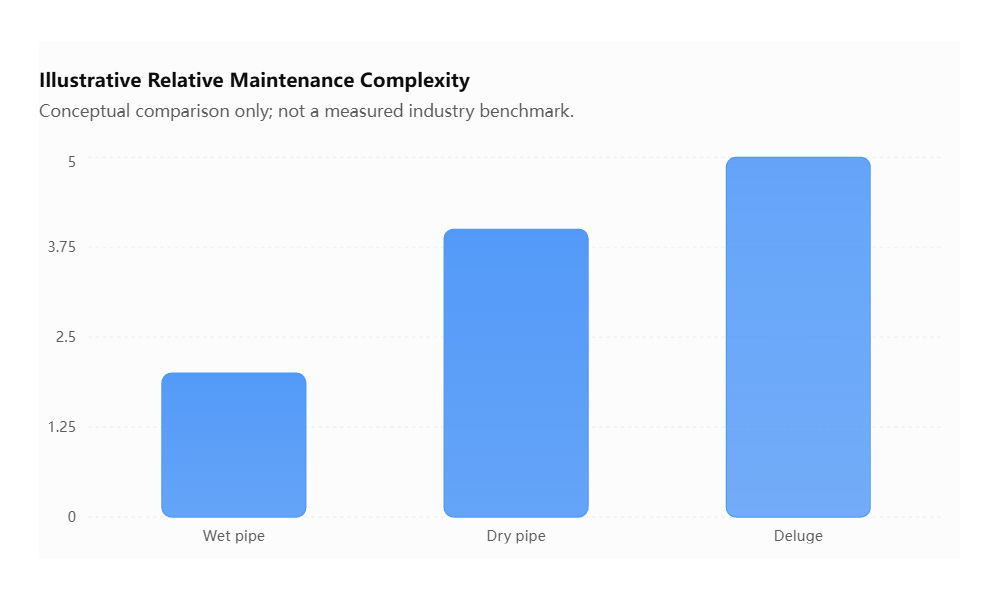
llustrative comparison of system complexity. Actual maintenance effort depends on the installation, exposure, equipment, and governing requirements.
Routine inspection and testing may include valve position checks, alarm tests, pressure checks, internal inspections, and functional testing.
The exact intervals and procedures depend on the system and the applicable standard.
The NFPA guidance on sprinkler system deficiencies and impairments explains why routine checks are important for dependable fire protection.
All intrusive or discharge tests should be planned by qualified personnel. They must account for system impairment, water damage risk, and safe restoration.
NFPA Standards and International Compliance
International buyers often serve projects with different fire protection requirements.
Some contracts reference NFPA standards. Others follow EN standards, national rules, or project-specific specifications.
A product suitable for one market is not automatically approved for another.
For this reason, buyers should confirm the required standard before placing an order.
Important Fire Protection Standards
| Standard | General scope | Purchasing relevance |
|---|---|---|
| NFPA 13 | Installation of sprinkler systems | System design and installation |
| NFPA 15 | Water spray fixed systems | Relevant industrial water spray applications |
| NFPA 25 | Inspection, testing, and maintenance | Ongoing system maintenance |
| NFPA 72 | Fire alarm and signaling | Detection, alarm, and release interfaces |
| EN 12845 | Automatic sprinkler systems | Relevant European-market sprinkler installations |
| UL 193 | Alarm valves for fire-protection service | Relevant product certification |
| UL 260 | Dry pipe and deluge valves for fire-protection service | Relevant product certification |
The applicable edition must be confirmed with the project specification and authority having jurisdiction.
NFPA lists its fire protection codes and standards through its official publications system. Its 2026 edition of NFPA 25 addresses the inspection, testing, and maintenance of water-based systems.
Understanding Product Certifications
Product certificates are different from general company management certificates.
For example, ISO 9001 concerns quality management systems. It does not, by itself, establish that a fire protection valve is listed or approved for a specific installation.
Buyers should check whether the offered product requires a recognized listing or approval.
Where specified, this may include UL listing, FM approval, or another accepted certification.
How to Verify Supplier Documents
Before approving a purchase order, request:
- The applicable certificate or approval reference.
- Exact manufacturer and model identification.
- Covered sizes and pressure ratings.
- Approved installation and trim arrangements.
- Current technical datasheets and instructions.
- Any certification limitations or special conditions.
A certificate for one size or model does not necessarily apply to every valve in a manufacturer’s catalog.
This is especially important when comparing products from several overseas suppliers.
Download the correct technical information: Request the valve datasheet, dimensional drawing, trim diagram, pressure-loss data, and available approval documents from your supplier. These documents can help your engineers review the proposed equipment before procurement.
Common Procurement Mistakes and How to Avoid Them
International valve purchasing involves more than comparing unit prices.
A small mistake in product selection can create expensive problems during installation.
For example, a contractor may discover that the delivered valve has the wrong flange drilling. Another buyer may receive the correct valve body but an incomplete trim assembly.
Both problems can delay commissioning.
Buying by Nominal Diameter Alone
A DN150 valve from one manufacturer is not always a direct replacement for another DN150 valve.
Connection dimensions, installation height, trim clearance, and operating pressure may differ.
Ask for dimensional drawings and confirm the full installation arrangement.
Assuming All Valves Have the Same Approvals
A manufacturer may offer several similar product series.
Only certain models or sizes may fall within a given certification scope.
Never assume approval coverage from a brand name alone.
Ignoring Water Supply Conditions
The valve must work within the system’s pressure and hydraulic requirements.
Incorrect assumptions about pressure loss can affect the overall design.
Require product-specific hydraulic data where it is needed.
Ordering Incomplete Trim Packages
Some quotations cover only the main valve body. Others include accessories, gauges, switches, and test connections.
Compare offers against a common bill of materials.
Otherwise, the apparent price difference may be misleading.
Overlooking After-Sales Documentation
A lower purchase price can become expensive if installation instructions or spare parts are unavailable.
Ask whether replacement seals, gauges, trim components, and maintenance instructions are available for the offered model.
For contractors and distributors, technical support is part of the product’s long-term value.
A clear purchase specification helps both sides avoid misunderstandings.
Manufacturer Selection and Sourcing Checklist
Choosing a fire protection valve manufacturer is a long-term business decision.
For importers and distributors, product consistency affects customer satisfaction, stock planning, and warranty handling.
For EPC contractors, incorrect equipment can affect project approvals and completion schedules.
A reliable sourcing process should evaluate technical capability before commercial terms.
Questions to Ask a Manufacturer
| Evaluation area | Questions for the supplier |
|---|---|
| Product range | Which valve types and sizes are manufactured or supplied? |
| Technical capability | Can you provide complete dimensional and trim drawings? |
| Material control | Are material certificates and batch records available? |
| Quality control | Which pressure and functional tests are performed? |
| Certifications | Which exact models hold the required approvals? |
| Customization | Can approved configurations support specific connection or packaging needs? |
| Production | What are the confirmed MOQ and production lead time? |
| Spare parts | Are maintenance kits and replacement parts available? |
| Export packing | How are valves protected against damage and moisture? |
| Documentation | Can documents be supplied in the required language? |
Evaluate the Complete Cost
Unit price is only one part of total purchasing cost.
You should also consider freight, import duties, inspection costs, installation requirements, and spare parts.
A technically suitable valve with complete documentation may provide better overall value than a cheaper but poorly documented product.
OEM and Private Label Requirements
Distributors may require custom cartons, product labels, or private label packaging.
These services should be discussed early.
However, changes to safety-critical components, markings, or certified configurations must be reviewed against applicable approval conditions.
OEM packaging does not mean a manufacturer can freely change a listed valve design.
FAQ
What is the main difference between a wet alarm valve and a dry pipe valve?
A wet alarm check valve is used with sprinkler piping already filled with pressurized water. A dry pipe valve holds water below piping containing pressurized gas. Dry systems are often selected where freezing makes conventional wet piping unsuitable.
Can a wet alarm valve be used in an unheated warehouse?
It depends on the environment and the protection provided. Water-filled piping must be protected from freezing. If the building cannot maintain suitable conditions, the fire protection engineer may recommend a dry system or another approved arrangement.
Is a deluge valve faster than a wet pipe system?
Not necessarily. Wet systems deliver water from piping already filled with water when a sprinkler opens. Deluge systems can release water through multiple open outlets after detection and valve operation. Actual response depends on the complete system design.
Do deluge systems use automatic sprinklers?
A typical deluge system uses open sprinklers or nozzles. These outlets do not individually open in response to heat. Instead, a separate detection or manual release system activates the deluge valve, allowing water to discharge through the open outlets.
What pressure rating should I choose for a fire sprinkler valve?
The required rating depends on the maximum expected system pressure, hydraulic design, and project specification. Verify the valve’s listed working pressure and any special operating conditions. Never select equipment based only on normal operating pressure.
What is the difference between a deluge valve and a preaction valve?
A deluge system normally uses open outlets and releases water through them when activated. A preaction system generally uses closed sprinklers and a separate detection arrangement. Its release logic depends on the approved configuration.
How often should sprinkler alarm valves be tested?
Testing frequency depends on the valve type, system arrangement, applicable edition of NFPA 25, and local requirements. Different inspections and functional tests have different intervals. Qualified personnel should follow the governing maintenance program and manufacturer’s instructions.
Are UL-listed fire protection valves required for every international project?
No. Certification requirements vary by country, project, insurer, and authority having jurisdiction. Some contracts specify UL listing, FM approval, or other certifications. Buyers should confirm the required approval before placing an order.
Can a manufacturer provide customized valve connections and packaging?
Manufacturers may offer approved connection variants, labeling, and export packaging options. However, changes that affect a certified design may require additional approval. Confirm the manufacturer’s actual capabilities and certification scope before ordering customized products.
What information should I provide when requesting a valve quotation?
Provide the valve type, nominal diameter, working pressure, connection requirements, quantity, and destination. Include applicable standards, required certificates, trim configuration, and project drawings. These details help manufacturers avoid unsuitable product recommendations and inaccurate quotations.
Conclusion
Wet, dry pipe, and deluge valves serve different purposes in fire protection systems.
A wet system is generally well suited to buildings where water-filled pipes can be protected from freezing. Its straightforward arrangement makes it a practical choice for many commercial projects.
A dry system is often used in freezing environments. It keeps water out of most sprinkler piping during normal operation, but it requires extra equipment and maintenance.
A deluge system provides a different approach. Its open outlets allow water to discharge across a selected hazard area after the releasing system operates.
For overseas importers, contractors, and distributors, the most important purchasing decision is matching the valve and its approved configuration to the fire protection design.
Technical documentation, material quality, hydraulic performance, certification scope, and after-sales support should all be part of your supplier evaluation.
Looking for a Fire Protection Valve Manufacturer?
If you’re sourcing fire protection equipment for an upcoming project, Yinglong Fire can be contacted to discuss available products and technical requirements.
Share your valve specifications, project drawings, required approvals, purchase quantities, and destination market.
Contact Yinglong Fire to request product information, technical documentation, and a quotation based on your project requirements.