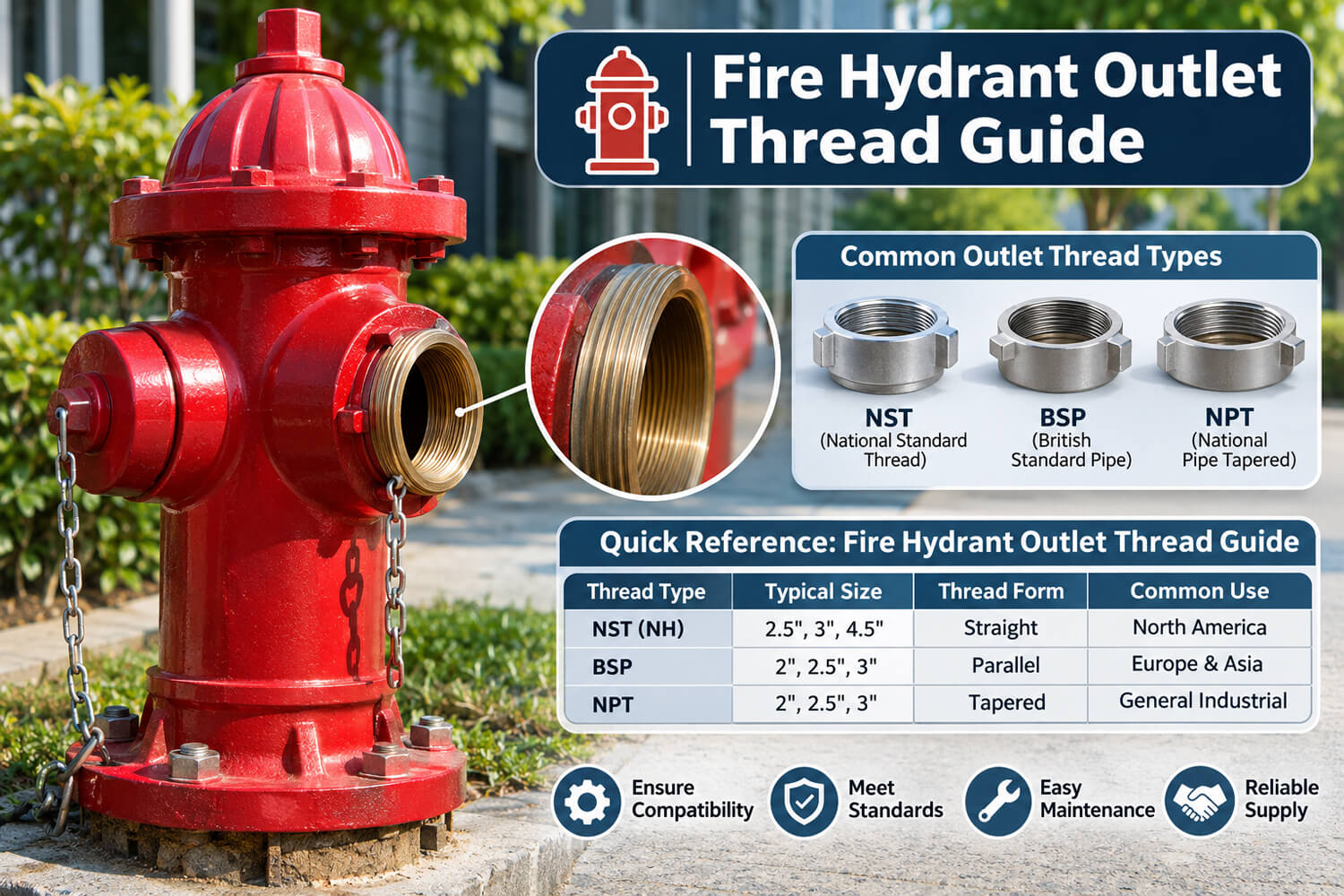
Fire hydrant outlet threads are standardized or locally specified connections that allow fire hoses, couplings, adapters, and firefighting equipment to connect securely to a hydrant. Common thread types include NH, NST, NPSH, BSP, and NPT. Selecting the correct outlet requires checking its diameter, thread pitch, connection design, sealing method, pressure rating, and local fire protection requirements.
A fire hydrant may look simple from the outside. However, its connection system requires a high level of manufacturing accuracy. Even a small difference in thread dimensions can prevent two components from connecting properly.
For fire equipment importers, distributors, and engineering contractors, ordering the wrong connection type can lead to costly replacements, project delays, and safety risks.
Different countries and regions also follow different firefighting standards. A hydrant designed for the American market may not be compatible with equipment commonly used in Europe or Asia.
This Fire Hydrant Outlet Thread Guide explains the technical details you should understand before sourcing hydrants, replacement nozzles, caps, and related firefighting accessories.
Fire Hydrant Outlet Thread Guide
A fire hydrant outlet thread is the machined connection on a hydrant nozzle that allows compatible equipment to be attached. It provides mechanical strength and helps maintain a secure connection during firefighting operations.
Most conventional threaded hydrant outlets feature external male threads. Fire hose couplings and protective caps normally feature matching internal female threads.
Together, these components form a connection that can handle the mechanical loads associated with pressurized water delivery.
Main Components of a Hydrant Outlet Connection
| المكوّن | Primary Function |
|---|---|
| Outlet nozzle | Provides the water discharge connection |
| Male thread | Connects with a compatible female fitting |
| Female coupling | Attaches the fire hose or accessory |
| Sealing face | Provides a surface for the gasket |
| Rubber gasket | Helps prevent water leakage |
| Protective cap | Protects the outlet against damage and dirt |
| Retaining chain | Helps prevent the loss of the protective cap |
Why Thread Accuracy Matters
Fire hydrant connections must perform reliably under demanding conditions. An incorrect thread may appear to fit but fail to engage correctly.
Accurate manufacturing provides several benefits:
- Better compatibility with existing firefighting equipment.
- Reduced risk of water leakage.
- Faster and easier equipment connection.
- Longer component service life.
- Lower replacement and maintenance costs.
- More consistent product quality across bulk orders.
For B2B buyers, thread accuracy also affects inventory management. If you distribute hydrants across several countries, you may need different outlet configurations for each market.
It is equally important to distinguish the hydrant’s outlet connection from its water supply inlet. A hydrant with a 6-inch inlet does not necessarily have a 6-inch hose connection.
The outlet size, thread designation, and inlet dimensions should appear separately on the technical drawing.
Before confirming an order, always request detailed connection specifications. A product description that simply states “2.5-inch outlet” does not provide enough information to guarantee compatibility.
Common Fire Hydrant Outlet Thread Types
Several connection systems are used throughout the global fire protection industry. Each system has its own dimensions, thread profile, and sealing requirements.
Understanding these differences helps you avoid purchasing incompatible equipment.
NH and NST Threads
NH stands for National Hose, while NST stands for National Standard Thread. In the fire equipment industry, both terms commonly refer to the same American fire hose connection thread system.
NH/NST connections are widely used in the United States, especially for municipal hydrants and firefighting equipment.
NPSH Threads
National Pipe Straight Hose threads are parallel threads commonly found on hose fittings and certain firefighting accessories.
Although their appearance may resemble NH connections, their dimensions are different. You should not assume that an NPSH fitting will match an NH outlet.
NPT Threads
National Pipe Taper threads are commonly used in American piping systems.
Unlike parallel fire hose connections, NPT threads have a tapered profile. They are more commonly associated with pipe fittings and fixed equipment connections.
BSPP and BSPT Threads
British Standard Pipe Parallel and British Standard Pipe Taper connections are widely used in international piping and firefighting equipment.
BSPP connections generally require a separate sealing arrangement. BSPT connections use a tapered threaded joint designed for pressure sealing with an appropriate mating thread and sealing method.
Fire Hydrant Thread Type Comparison
| Thread Type | الاسم الكامل | Thread Form | Typical Application |
|---|---|---|---|
| NH | National Hose | Parallel | Municipal fire hydrants |
| NST | National Standard Thread | Parallel | Fire hose connections |
| NPSH | National Pipe Straight Hose | Parallel | Hose fittings and accessories |
| NPT | National Pipe Taper | Tapered | Pipe and equipment connections |
| BSPP | British Standard Pipe Parallel | Parallel | International fittings and adapters |
| BSPT | British Standard Pipe Taper | Tapered | Fixed piping connections |
| Special Thread | Local or custom specification | Varies | Municipal and OEM projects |
NH and NPSH hose coupling dimensions differ, while NPT and BSP threads follow separate pipe thread standards. ASME+3
For distributors serving multiple markets, maintaining a clear product identification system is essential. Similar nominal dimensions do not mean that two products are interchangeable.
Fire Hydrant Outlet Sizes and Thread Dimensions
Fire hydrants are available with different outlet sizes to meet various water delivery requirements.
Smaller outlets are commonly designed for hose connections. Larger outlets are often used to supply firefighting vehicles through pumper hoses.
However, the nominal outlet size does not represent the actual outside diameter of its thread.
For example, a standard 2.5-inch NH male thread has a basic major diameter of approximately 3.069 inches.
Fire Hydrant NH/NST Thread Size Chart
| الحجم الاسمي | Thread Designation | Threads per Inch | Basic Male Major Diameter |
|---|---|---|---|
| 1½” | 1.5-9 NH | 9 | 50.55 mm |
| 2½” | 2.5-7.5 NH | 7.5 | 77.94 mm |
| 3″ | 3-6 NH | 6 | 92.05 mm |
| 3½” | 3.5-6 NH | 6 | 107.80 mm |
| 4″ | 4-4 NH | 4 | 127.28 mm |
| 4½” | 4.5-4 NH | 4 | 146.33 mm |
| 5″ | 5-4 NH | 4 | 159.00 mm |
| 6″ | 6-4 NH | 4 | 178.44 mm |
These are reference basic dimensions for selected NH thread sizes. Actual manufactured dimensions must meet the applicable tolerances. Not every size listed is a typical municipal hydrant outlet. ettfire.com+4
Understanding Thread Measurements
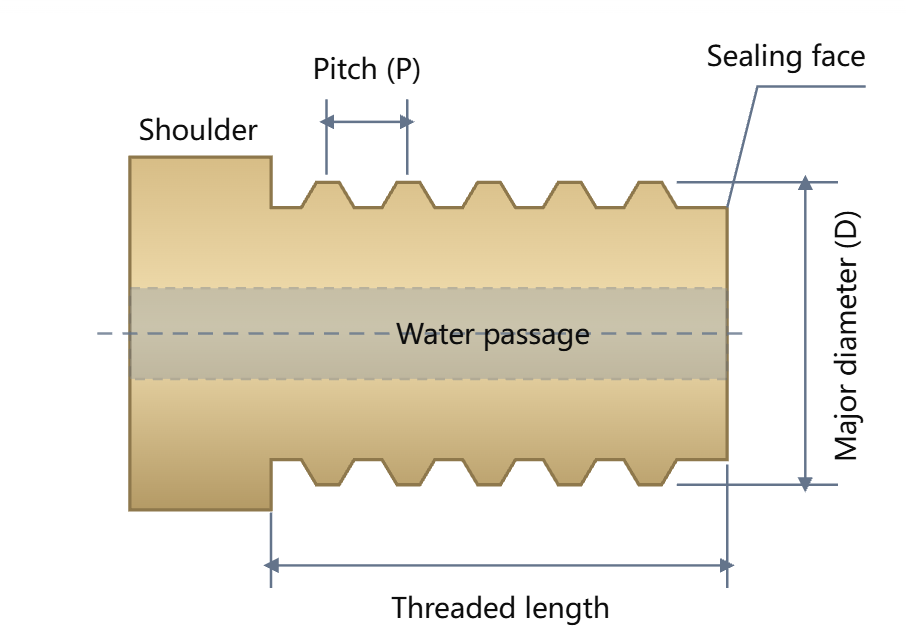
Illustration: Basic dimensions of a male threaded hydrant outlet. Schematic only; not an engineering production drawing.
The major diameter represents the largest diameter of the external thread. Thread pitch describes the distance between corresponding points on neighboring threads.
Threads per inch, commonly called TPI, indicate the number of thread cycles within one inch.
These parameters are especially important when comparing products from different suppliers.
For example, a 2.5-inch NH connection uses 7.5 TPI, while a 2.5-inch NPSH connection uses 8 TPI. Their major diameters also differ.
Comparison of Common 2.5-Inch Connections
| المعلمة | 2.5″ NH/NST | 2.5″ NPSH |
|---|---|---|
| Nominal size | 2.5″ | 2.5″ |
| Basic major diameter | 3.0686″ | 2.8434″ |
| TPI | 7.5 | 8 |
| Thread form | Parallel | Parallel |
| Direct interchangeability | لا يوجد | لا يوجد |
For wholesale purchasing, always specify the complete thread designation rather than relying on the nominal connection size.
International Fire Hydrant Thread Standards
International standards provide a common technical framework for designing, manufacturing, inspecting, and purchasing fire protection equipment.
Nevertheless, there is no single outlet connection that fits every hydrant worldwide.
Buyers must understand both international standards and local project requirements.
Major Fire Hydrant and Connection Standards
| قياسي | Organization | Main Coverage |
|---|---|---|
| معيار NFPA 1960 | NFPA | Fire hose connections and other firefighting equipment |
| NFPA 1963 | NFPA | Legacy standalone fire hose connection standard |
| AWWA C502 | AWWA | Dry-barrel fire hydrants |
| AWWA C503 | AWWA | Wet-barrel fire hydrants |
| ASME B1.20.7 | ASME | Hose coupling screw threads |
| ASME B1.20.1 | ASME | General-purpose pipe threads |
| BS 336 | BSI | Fire hose couplings and associated equipment |
| BS EN 14384 | BSI / CEN | Pillar fire hydrants |
| ISO 228-1 | ISO | Parallel pipe thread dimensions and tolerances |
| ISO 7-1 | ISO | Pipe threads designed for pressure-tight threaded joints |
NFPA Fire Hose Connection Requirements
NFPA 1963 has historically been an important reference for American firefighting connections.
However, its content has been consolidated into NFPA 1960, along with several other firefighting equipment standards. Buyers should check which edition their project specifications require.
You can learn more through the official صفحة المعيار NFPA 1960.
Fire Hydrant Connection Preferences by Market
| Market | Commonly Encountered Connections |
|---|---|
| United States | NH/NST, local threads and Storz |
| كندا | National and regional fire connections, Storz |
| United Kingdom | British instantaneous connections and BSP interfaces |
| Continental Europe | Storz and other national coupling systems |
| الشرق الأوسط | British, American and project-specific connections |
| Southeast Asia | British, American, Japanese and local systems |
| Africa | British and project-specific configurations |
These are general market references rather than mandatory countrywide specifications.
For example, some American cities use threaded hose outlets with a Storz pumper connection. Others specify different outlet sizes or local thread dimensions.
When supplying an international project, request the approved engineering specifications before production. This is more reliable than selecting an outlet based only on the destination country.
How to Identify Fire Hydrant Outlet Threads
Identifying an existing hydrant connection is an important step when purchasing replacement parts or sourcing compatible equipment.
Visual inspection alone is rarely enough. Different thread systems may have similar appearances but significantly different dimensions.
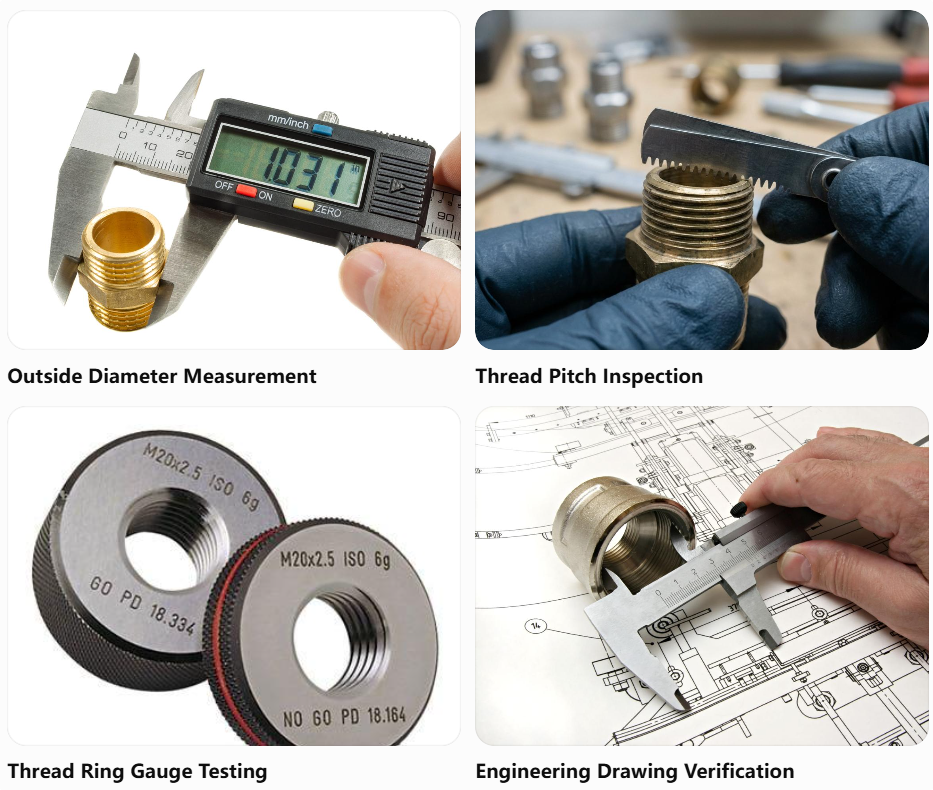
Check Existing Product Markings
Start by reviewing any identification marks on the nozzle, cap, coupling, or hydrant body.
Some manufacturers include the outlet size or thread designation on their products. Original technical documents may also provide useful information.
Measure the Outside Diameter
A qualified technician can use a calibrated vernier caliper to measure the outside diameter of the external thread.
Measurements should be compared with the relevant dimensional reference rather than the nominal pipe size.
Check the Thread Pitch
A thread pitch gauge helps identify the distance between neighboring thread crests.
Both the outside diameter and pitch must agree with the specified connection system.
Identify the Thread Profile
Determine whether the connection uses a parallel or tapered thread. The thread angle and profile also help distinguish different standards.
For example, common NPT threads use a 60-degree profile, while BSP threads use a 55-degree Whitworth profile.
Use Proper Thread Inspection Gauges
Calipers and pitch gauges are useful for preliminary identification. However, they cannot fully verify thread tolerances.
Manufacturers should use suitable calibrated thread plug gauges, ring gauges, or other approved measuring methods for final acceptance.
| Inspection Tool | Measurement Purpose |
|---|---|
| Vernier caliper | Major diameter and general dimensions |
| Thread pitch gauge | Thread pitch or TPI |
| Thread ring gauge | External thread conformity |
| Thread plug gauge | Internal thread conformity |
| Profile measuring equipment | Thread geometry |
| Approved reference sample | Connection comparison |
For replacement orders, sending a clearly identified sample to your supplier can help reduce uncertainty.
All inspections involving installed hydrants should be carried out by authorized personnel under appropriate safety procedures. Do not remove or modify pressurized components.
Fire Hydrant Thread and Hose Coupling Compatibility
A reliable connection depends on more than the nominal thread size. The complete mechanical and sealing design must match.
Two fittings may appear to connect for a short distance but still be incompatible. Partial thread engagement does not prove that a connection is suitable for firefighting service.
Thread Compatibility Reference Table
| Hydrant Outlet | Hose or Coupling Connection | Direct Compatibility |
|---|---|---|
| 2.5″ NH male | 2.5″ NH female | Yes, subject to complete specification |
| 2.5″ NH male | 2.5″ NST female | Yes, subject to complete specification |
| 2.5″ NH male | 2.5″ NPSH female | لا يوجد |
| 2.5″ NH male | 2.5″ BSP female | لا يوجد |
| 2.5″ NPT male | 2.5″ NH female | لا يوجد |
| Threaded NH outlet | Storz coupling | Requires a suitable adapter |
| Local special thread | Standard NH coupling | Requires verification or an approved adapter |
The Role of Fire Hydrant Adapters
Adapters allow different connection systems to work together when properly designed and approved.
Common configurations include NH-to-NPT, NH-to-BSP, and threaded-to-Storz adapters.
- Thread conversion adapter
- Reducing adapter
- Storz adapter
For equipment distributors, approved adapters can help expand product compatibility without stocking every possible hydrant configuration.
However, the adapter must meet the required pressure rating, dimensional specifications, material requirements, and local approval conditions.
Threaded Connections vs. Storz Connections
Storz is a threadless, symmetrical coupling system that uses locking lugs. It is increasingly used for large-diameter firefighting hose connections.
| الميزة | Threaded Connection | Storz Connection |
|---|---|---|
| Connection method | Screw engagement | Locking lugs |
| Male and female ends | Normally required | Symmetrical interface |
| Connection speed | Depends on thread engagement | Typically faster |
| Main sealing method | Depends on design; commonly a gasket | Gasket |
| Compatibility requirement | Thread size and profile | Coupling size and lug geometry |
| تطبيق نموذجي | Hose and pumper outlets | Large-diameter hose connections |
Some hydrant manufacturers offer integrated Storz pumper outlets as an alternative to traditional threaded connections.
For new infrastructure projects, selecting a connection that matches the local firefighting fleet can simplify training, inventory management, and long-term maintenance.
Fire Hydrant Outlet Materials and Manufacturing Quality
Thread accuracy begins with material selection and continues throughout the manufacturing process.
A hydrant outlet must withstand mechanical loads, repeated connections, environmental exposure, and internal water pressure.
Poor-quality machining can reduce the benefits of even a well-selected material.
Common Hydrant Outlet and Accessory Materials
| المواد | المزايا الرئيسية | Typical Application |
|---|---|---|
| برونز | Corrosion resistance and good machinability | Outlet nozzles |
| النحاس | Good machinability and corrosion resistance | Couplings and adapters |
| الحديد المطاوع | High mechanical strength | Hydrant bodies and selected components |
| الفولاذ المقاوم للصدأ | Strength and corrosion resistance | Specialized fittings |
| سبائك الألومنيوم | Lightweight and easy handling | Couplings and adapters |
| EPDM rubber | Water and weather resistance | Compatible sealing gaskets |
The exact material grade should be selected according to the product design, water conditions, pressure rating, and project requirements.
Manufacturing Process for Threaded Hydrant Outlets
Material Selection and Casting
Prepare the metal components according to the specified material grade and mechanical requirements.
CNC Thread Machining
Produce the required thread profile, diameter, pitch, and connection surfaces.
Dimensional Inspection
Verify thread conformity using appropriate measuring equipment and calibrated gauges.
Assembly and Performance Testing
Inspect the completed product and perform applicable sealing and pressure tests.
Final Inspection and Packaging
Protect machined surfaces and prepare correctly identified products for shipment.
Why CNC Machining and Thread Gauging Are Important
From a manufacturing perspective, the most important challenge is not simply producing a thread that looks correct. It is maintaining consistent dimensions throughout the entire production batch.
Cutting tool wear, material variation, and machining setup can affect the finished thread.
A suitable quality control system should include first-piece inspection, production checks, and final acceptance testing.
For OEM buyers, requesting a sample before mass production is particularly valuable. Once the technical drawing and sample have been approved, they can serve as quality references for future orders.
You should also ask whether replacement nozzles and caps will remain available with matching specifications. Long-term spare parts support can be just as important as the initial purchase price.
Common Fire Hydrant Thread Problems and Solutions
Fire hydrant connections are exposed to demanding environmental and operating conditions.
Over time, poor handling, corrosion, manufacturing defects, or incompatible equipment may affect their performance.
Understanding common problems helps distributors and contractors reduce product complaints and maintenance costs.
Common Problems, Causes and Preventive Measures
| Problem | Possible Cause | Recommended Response |
|---|---|---|
| Coupling cannot connect | Incorrect thread standard | Verify both connection specifications |
| Water leakage | Damaged gasket or sealing face | Arrange inspection and approved replacement |
| Cross-threading | Incorrect alignment or incompatible fitting | Inspect for damage and replace affected parts |
| Difficult connection | Dirt, corrosion or damaged threads | Arrange approved cleaning and inspection |
| Loose protective cap | Incorrect dimensions or thread wear | Use a compatible replacement cap |
| Premature corrosion | Unsuitable material or environmental exposure | Review material and protection requirements |
| Inconsistent batch quality | Machining variation | Strengthen production inspection |
| Damaged outlet | Impact or excessive mechanical force | Arrange professional assessment |
Preventing Cross-Threading
Cross-threading occurs when mating threaded parts become incorrectly aligned during engagement.
It may damage the first few threads and prevent the connection from reaching its intended position.
Good manufacturing practices, accurate thread profiles, and proper handling can help reduce this risk.
Reducing Leakage and Corrosion
A correctly manufactured thread does not automatically guarantee a leak-free connection.
The gasket condition, sealing face, and complete connection design must also meet their specifications.
Protective caps help prevent dirt and environmental contamination from entering unused outlets. Suitable material selection can further improve resistance to corrosion.
Managing Quality Across Large Orders
For bulk purchases, a single incorrect thread specification can affect hundreds of units.
This is why buyers should approve technical drawings before the production process begins. Products with different outlet specifications should also receive different identification labels.
If a component shows damage during inspection, it should be evaluated according to the manufacturer’s maintenance requirements.
Grinding, rethreading, or forcing an incompatible connection may create further safety risks. Repairs should only be performed through approved procedures by qualified personnel.
A preventive approach generally offers better long-term value than correcting compatibility issues after installation.
How to Choose a Fire Hydrant Outlet for Bulk Purchasing
Selecting a reliable fire hydrant manufacturer requires more than comparing prices and product photographs.
International buyers should consider technical compatibility, manufacturing consistency, spare parts availability, documentation, and delivery requirements.
A well-prepared request for quotation helps the manufacturer provide a more accurate offer.
Technical Information Required for an RFQ
| المعلمة | Example or Required Information |
|---|---|
| Destination market | USA, UK, Middle East or other region |
| Hydrant type | Dry barrel, wet barrel or pillar |
| وصلة المدخل | Flange size and standard |
| Hose outlet size | 2.5 inches |
| Hose outlet thread | 2.5-7.5 NH |
| Number of hose outlets | اثنان |
| Pumper outlet | 4.5-4 NH or specified Storz connection |
| ضغط التشغيل | As required by the project |
| Outlet material | Approved bronze or other specified material |
| Applicable standard | AWWA, EN or project specification |
| Certification requirements | UL, FM or other applicable approvals |
| كمية الطلب | Required number of units |
| OEM requirements | Branding, labels and packaging |
Fire Hydrant Procurement Checklist
Pre-order technical verification
[ ] Confirm the destination market and local fire service requirements
[ ] Specify the exact outlet thread designation
[ ] Confirm the number and size of hose outlets
[ ] Verify the pumper connection
[ ] Confirm working pressure and applicable testing requirements
[ ] Review material grades and sealing components
[ ] Request technical drawings and inspection documents
[ ] Approve a pre-production sample where required
[ ] Verify model-specific certifications
[ ] Confirm packaging and spare parts availability
Consider OEM Manufacturing Capabilities
A suitable manufacturer should be able to review your technical requirements before accepting an order.
OEM purchasing may involve customized thread specifications, outlet arrangements, protective caps, surface finishes, product identification, and export packaging.
For distributors, clear communication is particularly important when ordering products for multiple countries.
You should also confirm whether any customization affects existing product certifications. A certified standard model does not automatically mean that every modified configuration carries the same approval.
Evaluate Total Purchasing Costs
The initial unit price represents only one part of your purchasing cost.
Incorrect outlet specifications can lead to replacement shipments, additional adapters, delayed installations, and warranty disputes.
By choosing technically compatible products and establishing clear quality requirements, you can reduce these risks and build a more reliable supply chain.
الأسئلة المتداولة
What thread is used on a standard fire hydrant?
Many American municipal fire hydrants use NH or NST threads. Common configurations include 2.5-inch hose outlets and larger pumper outlets. However, local fire departments may require special threads or Storz connections. Always confirm the approved specifications before purchasing.
Are NH and NST threads the same?
Yes. In the firefighting equipment industry, NH and NST commonly describe the same American fire hose connection thread system. However, buyers should still verify the nominal size, thread pitch, dimensions, and sealing arrangement to ensure complete compatibility.
What is the thread pitch of a 2.5-inch fire hydrant outlet?
A standard 2.5-inch NH fire hose connection has 7.5 threads per inch. Its basic external major diameter is 3.0686 inches. Other nominally 2.5-inch connections may have different diameters and thread pitches, so the thread standard must also be identified.
Are NPT and NST threads interchangeable?
No. NPT uses a tapered pipe thread, while NST uses a parallel fire hose connection thread. Their dimensions and sealing principles differ. A properly designed and approved adapter is required when connecting incompatible systems.
Are BSP and NPT fire hydrant threads compatible?
BSP and NPT threads are generally not interchangeable. They have different thread profiles and may also differ in pitch and dimensions. Using an unsuitable connection can damage the components and create leakage risks. Always specify the exact thread type when ordering.
What is the difference between a hose outlet and a pumper outlet?
A hose outlet generally connects to a smaller firefighting hose. A pumper outlet typically provides a larger connection for supplying firefighting vehicles. Their dimensions and connection systems vary depending on hydrant design, local firefighting equipment, and municipal requirements.
Can a fire hydrant manufacturer produce customized outlet threads?
Customized threads may be available through OEM manufacturing. Buyers should provide approved engineering drawings, complete dimensional specifications, or verified reference samples. Any customization must also be reviewed for pressure performance, compatibility, and applicable certification requirements before production.
What is a Storz fire hydrant connection?
A Storz connection is a symmetrical, threadless coupling that uses locking lugs. It allows compatible firefighting hoses to connect without traditional screw-thread engagement. Storz connections are frequently used for larger hose sizes and pumper outlets where rapid connection is important.
Does the fire hydrant outlet thread determine its pressure rating?
No. Pressure performance depends on the complete product design, materials, wall thickness, thread engagement, sealing arrangement, and manufacturing quality. Buyers should confirm the rated working pressure and required test documentation for the specific hydrant and connection configuration.
How can I ensure consistent thread quality in bulk orders?
Provide a complete technical specification and approve the engineering drawing before production. Request appropriate thread gauge inspection, dimensional records, and performance test documentation. Separate product identification for different thread types can also help prevent mixing during packaging and shipment.
الخاتمة
Selecting the correct fire hydrant outlet connection is essential for equipment compatibility, reliable water delivery, and long-term operational safety.
Although NH and NST threads are widely used in American firefighting systems, other markets may require BSP interfaces, special municipal threads, British instantaneous connections, or Storz couplings.
Understanding the differences between these systems helps you make better purchasing decisions.
For importers, wholesalers, and engineering contractors, the most important considerations include thread accuracy, material quality, sealing performance, manufacturing consistency, and compliance with local requirements.
A reliable manufacturing partner should understand these requirements and provide the technical documentation needed to support your purchasing decisions.