Choosing between an automatic vs manual fire hose reel mainly depends on the water inlet valve, activation mechanism, installation requirements, maintenance needs, and purchasing cost. Automatic models open the water supply as the hose unwinds, while manual models require users to open a separate valve. Both designs can provide effective fire protection when properly specified, installed, and maintained.
Fire hose reels are essential firefighting equipment in commercial buildings, warehouses, factories, hotels, and public facilities. However, products that look nearly identical may have very different internal structures and operating requirements.
For international buyers, these differences can affect project approval, installation costs, spare parts management, and long-term customer satisfaction.
Whether you are importing firefighting equipment or purchasing products for a construction project, understanding these technical differences helps you avoid costly specification errors.
This guide explains what changes between the two designs and what you should confirm with your manufacturer before placing a bulk order.
Automatic vs Manual Fire Hose Reel: Understanding the Basic Differences
A fire hose reel is a fixed firefighting device connected to a building’s water supply. It provides a controlled water stream for initial firefighting where its use is appropriate and permitted.
A typical assembly includes a rotating drum, semi-rigid hose, water inlet, mounting bracket, shut-off nozzle, and control valve.
The main difference between the two types is how water enters the hose.
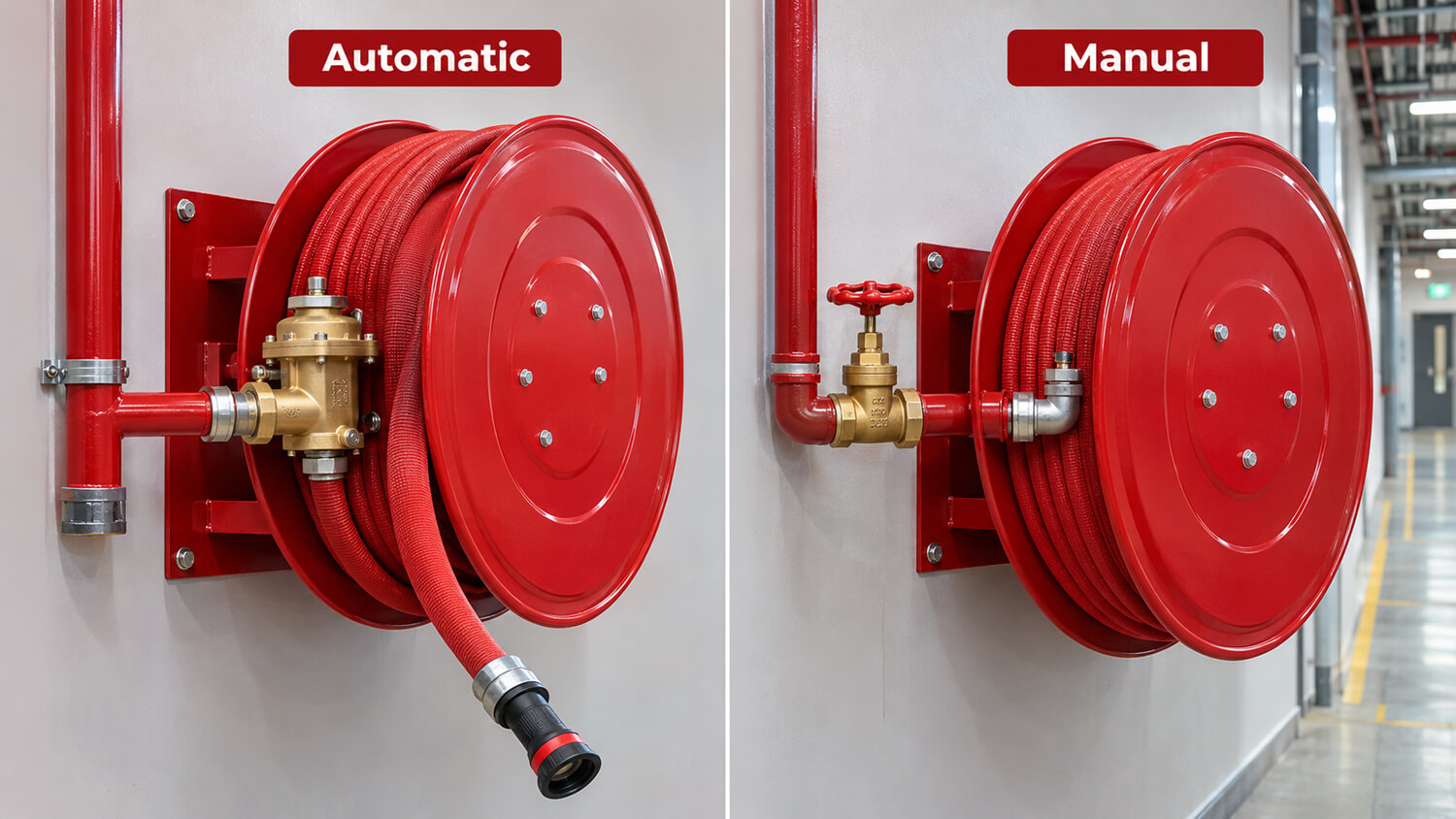
Automatic Fire Hose ReelIntegrated mechanical water inlet activation.
Manual Fire Hose ReelSeparate manually operated water inlet valve.
How Does a Manual Fire Hose Reel Work?
A manual model uses a separate inlet stop valve. The user must open this valve to allow water into the hose. Water discharge is then controlled through the nozzle.
This design has a relatively simple mechanical structure. Its components are generally easy to identify, inspect, and replace.
For firefighting equipment distributors, this can simplify spare parts management and after-sales support.
How Does an Automatic Fire Hose Reel Work?
An automatic model contains a valve connected to the reel’s rotation mechanism. Unwinding the hose activates the valve and allows water to enter the hose.
The nozzle still controls the final water discharge.
Most conventional automatic models use mechanical activation rather than electricity. They do not require a separate electrical motor to open the inlet valve.
Water supply activation comparison
Conceptual comparison of the water path and inlet control mechanism.
It is important to understand that automatic activation does not mean automatic fire detection or suppression. Both systems still require human operation.
The better choice depends on your project specifications, local regulations, user training, and maintenance resources.
Automatic vs Manual Fire Hose Reels: What Changes in the Specification?
When buyers request quotations from several manufacturers, they often compare hose length, drum diameter, and unit price first. However, these factors only explain part of the product’s value.
The inlet mechanism can influence several other components. It may also change installation drawings, maintenance requirements, and the final purchasing cost.
The following comparison highlights seven major specification differences.
| Specification | Automatic Fire Hose Reel | Manual Fire Hose Reel |
|---|---|---|
| Water inlet valve | Integrated automatic valve | Separate manual stop valve |
| Activation method | Activated by reel rotation | Activated by hand |
| الآلية الداخلية | Additional mechanical activation components | Relatively simple valve structure |
| Installation requirements | Automatic valve assembly and suitable isolation access | Accessible manual valve and operating clearance |
| Quality inspection | Includes automatic activation testing | Includes manual valve operation testing |
| الصيانة | Requires inspection of the activation mechanism | Generally simpler valve servicing |
| Manufacturing cost | أعلى بشكل عام | أقل بشكل عام |
Several other specifications can remain the same between the two products.
| Common Specification | Typical Configuration |
|---|---|
| Hose inside diameter | 19 mm, 25 mm or 33 mm |
| طول الخرطوم | 20 m, 25 m or 30 m |
| Drum material | Coated steel |
| Nozzle material | Brass or suitable engineering plastic |
| Mounting type | Fixed or swinging |
| معالجة الأسطح | Powder coating or other protective finish |
| Nozzle function | Shut-off, jet and spray, depending on design |
| التطبيق | Commercial and industrial building protection |
These are general configuration examples, not guaranteed specifications for every product model.
For procurement teams, the most important point is that automatic operation does not necessarily improve hydraulic performance. Two products with identical hose dimensions and similar flow characteristics may provide comparable water delivery.
When comparing quotations, make sure every supplier is pricing the same configuration.
For example, a quotation for a 25 mm × 30 m automatic swinging reel should not be compared directly with a 19 mm × 20 m manual fixed reel.
The price difference may come from several components rather than the activation mechanism alone.
A detailed specification sheet helps you make a fair comparison, reduce order disputes, and deliver products that meet your customer’s expectations.
Water Inlet Valve and Activation Mechanism
The water inlet valve is the most important component that separates the two designs.
Although the outer drum and hose may look similar, the valve assembly changes how the entire product operates.
Manual Inlet Valve Construction
Manual models normally feature a hand-operated inlet valve. Depending on the design, this may be a screw-down valve or a quick-opening valve.
Common construction materials include brass and other suitable corrosion-resistant metals.
The valve must remain accessible after installation. If it is positioned inside a cabinet, sufficient space must be available for operation and servicing.
A poorly positioned valve can make an otherwise suitable product difficult to use.
Automatic Valve Construction
Automatic models use an inlet mechanism linked to drum rotation.
Depending on the manufacturer’s design, the assembly may contain a spindle, moving mechanical parts, seals, and an integrated valve body.
These additional components require accurate manufacturing and assembly. Their movement must remain consistent after repeated operation.
Under EN 671-1:2012, the automatic inlet valve must reach its fully open position within three complete reel rotations. The valve must also remain free from visible leakage during the relevant test. Part 1:+1
For buyers, this makes the activation mechanism an important part of factory acceptance testing.
Your purchasing specification should cover:
- Valve body material and connection size.
- Automatic opening performance.
- Sealing materials and leakage resistance.
- Availability of replacement valve assemblies.
- Compatibility with the selected hose and reel structure.
- Access to the water supply isolation valve.
Water hammer is another factor to consider. Rapid changes in water flow may create pressure surges within the supply piping.
The correct valve design must therefore be selected as part of the complete fire protection system.
A reliable product is not simply one that opens quickly. It must also open consistently, maintain its sealing performance, and match the operating conditions of your project.
Hose Diameter, Length, Working Pressure and Flow Rate
Hydraulic performance is one of the most important considerations when purchasing firefighting equipment.
However, buyers should not assume that an automatic reel delivers more water than a manual model.
The available water flow depends on the complete assembly and its water supply.
Fire Hose Diameter and Length
Under EN 671-1, the specified internal hose diameters include 19 mm, 25 mm, and 33 mm.
A larger internal diameter can reduce friction losses under comparable flow conditions. However, it may also increase product weight, storage requirements, and handling effort.
| Hose Diameter | Approximate Inch Size | General Characteristics |
|---|---|---|
| 19 mm | 3/4 inch | Compact configuration and easier handling |
| 25 mm | 1 inch | Balance between size and water delivery |
| 33 mm | Approximately 1.3 inches | Larger hose bore and heavier assembly |
Hose length should be selected according to the building layout and approved coverage design.
A longer hose increases reach, but it may also increase friction losses. The required hose length should never be determined by floor area alone.
Fire Hose Reel Pressure Ratings
EN 671-1:2012 provides the following pressure parameters for the relevant reel assemblies.
| Hose Diameter | Maximum Working Pressure | Test Pressure | Minimum Burst Pressure |
|---|---|---|---|
| 19 mm | 12 bar | 18 bar | 30 bar |
| 25 mm | 12 bar | 18 bar | 30 bar |
| 33 mm | 7 bar | 10.5 bar | 17.5 bar |
Source: EN 671-1:2012, Table 2. These values describe standard requirements rather than the verified ratings of a particular supplier’s product.
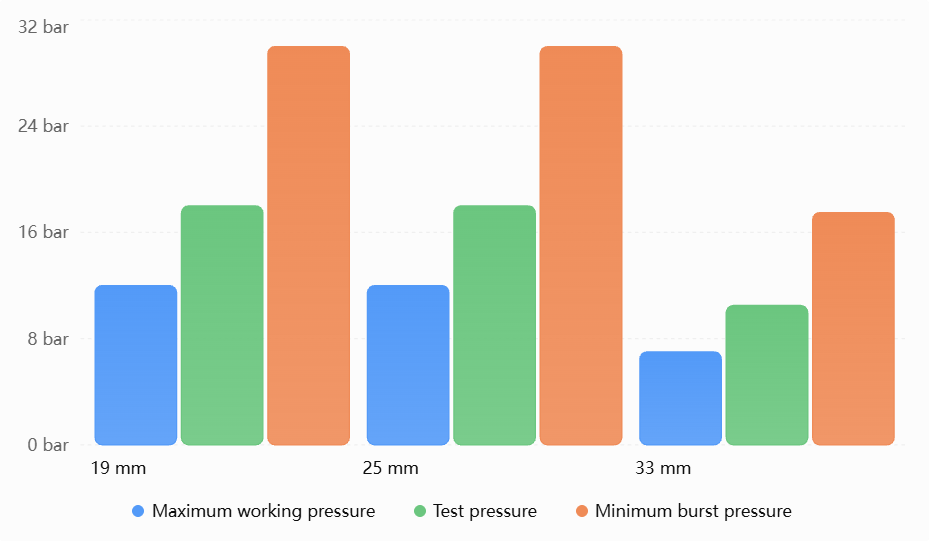
Working pressure describes the permitted service pressure. Test pressure is used for specified verification procedures. Burst pressure relates to destructive strength testing.
These values must not be used interchangeably.
What Determines Water Flow?
Water delivery depends on inlet pressure, valve resistance, hose dimensions, nozzle opening, and friction losses.
For a project order, request the flow test results at the required inlet pressure. A maximum pressure rating alone does not confirm that a product meets your required flow rate.
This distinction is particularly important when supplying equipment for large commercial buildings or industrial facilities.
Manufacturing Materials and Component Construction
Material selection has a direct impact on durability, corrosion resistance, product weight, and manufacturing cost.
Automatic and manual models often share many structural components. However, the automatic valve introduces additional material and assembly requirements.
Steel Reel Drum
Brass Valve Assembly
Semi-Rigid Hose
Shut-Off Nozzle
Reel Drum and Mounting Structure
Coated carbon steel is a common material for the reel drum and mounting bracket.
It provides structural strength while keeping manufacturing costs manageable. Protective coatings help reduce surface corrosion during storage and service.
For coastal projects or industrial environments, buyers may need additional corrosion protection.
Valve Body and Internal Components
Brass is commonly used for water inlet valves because of its machinability and corrosion resistance.
Automatic models may also contain additional metal or engineering plastic components. Their material selection must suit the mechanical loads, water conditions, and expected operating life.
| المكوّن | خيارات المواد الشائعة | Key Purchasing Consideration |
|---|---|---|
| Drum | فولاذ كربوني مطلي | Strength and coating quality |
| Mounting bracket | Carbon steel or stainless steel | Load capacity |
| جسم الصمام | Brass or suitable metal alloy | Pressure and corrosion resistance |
| Spindle | النحاس أو الفولاذ المقاوم للصدأ | Wear resistance |
| Seals | EPDM, NBR or suitable elastomers | Water and temperature compatibility |
| Hose | Reinforced rubber or polymer construction | Flexibility and pressure resistance |
| فوهة | Brass or engineering plastic | Durability and water control |
These materials are examples. The actual grades and properties should appear in the approved product specification.
From a manufacturing perspective, dimensional consistency is just as important as raw material selection.
Incorrect alignment between the drum, spindle, and valve can create uneven movement. Poorly controlled sealing surfaces can also affect leakage resistance.
For bulk purchasing, ask your supplier to confirm the materials before production begins. This helps prevent unauthorized component changes between production batches.
Fixed and Swinging Fire Hose Reel Installation
The activation mechanism and mounting method are two separate product characteristics.
An automatic reel is not necessarily a swinging reel. Likewise, a manual reel is not limited to fixed installation.
Buyers can generally find four basic configurations.
Manual Fixed Type
Manual Swinging Type
Automatic Fixed Type
Automatic Swinging Type
Fixed Fire Hose Reels
A fixed reel remains in its installed position while the drum rotates.
This design can be suitable for open wall spaces and projects with straightforward hose routing. A suitable hose guide may be needed to support withdrawal in different directions.
Fixed designs can also offer a relatively compact installation arrangement.
Swinging Fire Hose Reels
A swinging reel includes a pivoting mounting arm or bracket.
The assembly can move outward from its mounting position. This provides additional flexibility when installed inside a cabinet or near an opening.
The bracket must support the weight of the reel, hose, and contained water. Its movement must also remain clear of nearby walls, doors, and piping.
Fire Hose Reel Cabinet Requirements
Cabinet dimensions should be based on the complete assembly rather than drum diameter alone.
Manual models require enough space to operate the inlet valve. Automatic models require suitable access to the activation assembly and water isolation arrangements.
Before ordering, request dimensional drawings that show:
- Overall reel width, height, and depth.
- Water inlet location and connection orientation.
- Mounting hole positions.
- Swing arm dimensions and movement range.
- Cabinet clearance requirements.
- Valve accessibility.
Poor coordination between the reel manufacturer and cabinet supplier can result in expensive installation changes.
For MEP contractors, approving these drawings before bulk production is an effective way to reduce on-site rework.
International Standards and Fire Safety Certification
Compliance is a critical purchasing consideration for overseas firefighting equipment buyers.
A product that meets the requirements of one market may not automatically be accepted in another. Local authorities may specify different testing, labeling, installation, or approval requirements.
EN 671-1 Requirements
BS EN 671-1:2012 – Fixed Firefighting Systems is an important reference for permanently installed hose reel assemblies with semi-rigid hoses.
It addresses both manual and automatic product configurations.
Its scope includes construction, hydraulic performance, operational characteristics, and relevant product testing.
EN 694 Fire Hose Requirements
EN 694 addresses semi-rigid hoses intended for fixed firefighting systems.
The hose must be suitable for its intended pressure and operating conditions. Hose compliance alone does not establish compliance of the complete reel assembly.
Other International Standards
| Standard or Regulation | Main Application |
|---|---|
| EN 671-1 | Fire hose reels with semi-rigid hoses |
| EN 694 | Semi-rigid firefighting hoses |
| EN 671-3 | Inspection and maintenance of hose systems |
| AS/NZS 1221 | Fire hose reel product requirements in Australia and New Zealand |
| AS 2441 | Fire hose reel installation requirements in Australia |
| AS 1851 | Routine servicing of fire protection equipment in Australia |
| Local fire authority requirements | Country-specific project acceptance |
Buyers should also understand the difference between product testing, third-party certification, and local project approval.
A supplier’s general statement about compliance is not always enough.
Request supporting documents that identify the actual product model, standard edition, and approved configuration. If third-party certification is required, confirm that its scope covers the model you intend to purchase.
Changes to the hose, nozzle, valve, or mounting mechanism may affect an existing approval.
For international distributors, maintaining accurate compliance records can reduce customs-related delays, tender rejection, and customer complaints.
Always confirm the applicable standard edition and local requirements before finalizing your order.
Inspection, Maintenance and Product Service Life
Fire hose reels may remain unused for long periods. However, they must be ready to operate when required.
Regular inspection is therefore essential, regardless of the activation design.
A manual model generally has fewer activation components. An automatic model adds a mechanical mechanism that requires additional attention during functional checks.
Manual Fire Hose Reel Maintenance
Typical maintenance considerations include valve movement, leakage, hose condition, nozzle operation, and drum rotation.
The separate inlet valve should remain accessible and operate smoothly.
Corrosion, deposits, or damaged seals can affect valve performance. These issues should be addressed by qualified maintenance personnel.
Automatic Fire Hose Reel Maintenance
Automatic assemblies require the same general inspections. Their activation mechanism must also be checked to confirm that the water inlet opens correctly.
Wear, poor alignment, deposits, or damaged internal components may affect this function.
Maintenance teams should have access to suitable replacement parts and model-specific technical instructions.
| Inspection Item | Manual Type | Automatic Type |
|---|---|---|
| Hose condition | ||
| Nozzle operation | ||
| Leakage inspection | ||
| Drum rotation | ||
| Mounting bracket condition | ||
| Manual inlet valve operation | As applicable | |
| Automatic activation mechanism | لا ينطبق |
The relevant European maintenance reference is EN 671-3. Local maintenance regulations may establish additional requirements.
For distributors, spare parts availability is an important part of supplier evaluation.
You should consider stocking compatible nozzles, seals, inlet valves, hose assemblies, and mounting components according to your installed product range.
A lower purchase price may offer little benefit if replacement parts become unavailable after several years.
Reliable documentation and continued component availability can extend the useful service life of equipment and protect your reputation with customers.
Purchase Price and Total Ownership Cost
Automatic fire hose reels generally have a higher manufacturing cost than equivalent manual models.
The additional cost mainly comes from the integrated valve assembly, mechanical components, machining requirements, and functional testing.
However, the final purchase price also depends on hose size, materials, mounting structure, certifications, order quantity, and packaging.
Manufacturing Cost Comparison
| Cost Factor | Manual Type | Automatic Type |
|---|---|---|
| Valve assembly | أقل بشكل عام | أعلى بشكل عام |
| Mechanical components | Fewer | More |
| Assembly complexity | Relatively simple | Relatively complex |
| الاختبار الوظيفي | Standard requirements | Additional activation verification |
| Hose and nozzle | Depends on specification | Depends on specification |
| Mounting structure | Depends on configuration | Depends on configuration |
| Certification expenses | Model-dependent | Model-dependent |
Understanding Total Ownership Cost
The initial quotation represents only one part of the buyer’s investment.
A complete purchasing evaluation should include transportation, installation, routine maintenance, replacement parts, and product documentation.
Fire hose reel total ownership cost
Product purchaseUnit price × order quantity
International transportationFreight, duties and handling
التركيبLabor, cabinets and connections
الصيانةInspection and scheduled servicing
Replacement partsValves, seals, hoses and nozzles
Total lifetime investment
For example, a distributor purchasing hundreds of units should consider how many spare part types must be stocked.
If several models use compatible hoses and nozzles, inventory management may become more efficient. Standardized packaging may also reduce warehouse handling costs.
However, component standardization must not compromise product approval or performance.
The automatic option may justify its additional cost when a project requires automatic water inlet activation. The manual option may offer better value when simplicity and maintenance efficiency are the main priorities.
Ask your manufacturer to provide quotations based on matching technical configurations.
This gives you a clearer understanding of the actual cost difference and helps you protect your profit margins without compromising safety.
How to Choose the Right Fire Hose Reel for Your Project
There is no single fire hose reel design that is suitable for every building.
Your selection should start with the project requirements rather than the appearance or price of the product.
The local fire regulations, approved system design, and required hydraulic performance must come first.
Commercial Buildings and Shopping Centers
Automatic models may be preferred where the approved design calls for fewer manual activation steps.
The equipment must remain clearly identified and accessible to authorized users.
Factories and Industrial Warehouses
Manual models can be a practical choice where trained personnel and established maintenance teams are available.
The final selection must consider the materials stored within the facility and its fire risks.
Hotels, Offices and Public Facilities
Cabinet size, signage, accessibility, and installation appearance can be important considerations.
Both activation designs may be suitable when approved for the intended application.
Coastal and Corrosive Environments
Corrosion resistance may become more important than the activation mechanism.
Buyers should pay close attention to coating quality, valve materials, mounting hardware, and environmental protection.
| Project Priority | Selection Consideration |
|---|---|
| Automatic water inlet activation | Automatic model |
| Simple mechanical construction | Manual model |
| Lower initial purchasing cost | Generally manual model |
| Restricted cabinet space | Confirm complete assembly dimensions |
| Flexible hose withdrawal direction | Consider swinging configuration |
| High corrosion exposure | Specify suitable protective materials |
| Mandatory product certification | Select a verified, approved model |
These are general purchasing considerations rather than universal application rules.
As a buyer, provide your supplier with the intended installation environment and project specification. This information helps the manufacturer recommend a suitable configuration.
A well-selected product should meet the project’s safety requirements while remaining practical to install, operate, inspect, and maintain.
Fire Hose Reel Manufacturer: B2B Procurement Checklist
Working directly with an experienced firefighting equipment manufacturer can improve product consistency and simplify technical communication.
For wholesale orders, we recommend confirming the full technical specification before production.
A clear purchase specification reduces misunderstandings and allows both parties to agree on the required product configuration.
Technical Specification Checklist
Fire Hose Reel RFQ Checklist
Fire Hose Reel RFQ Checklist
[ ] Automatic or manual inlet valve
[ ] Fixed or swinging mounting structure
[ ] Hose internal diameter and total length
[ ] Working pressure and required flow performance
[ ] Water inlet connection size and thread type
[ ] Drum, bracket and valve materials
[ ] Surface treatment and corrosion requirements
[ ] Nozzle material and discharge settings
[ ] Applicable standards and certification documents
[ ] Product labels, instructions and packaging
[ ] Order quantity and spare parts requirements
[ ] Dimensional drawings and sample approval
Factory Quality Control Requirements
Before approving a supplier, ask how product quality is controlled throughout manufacturing.
01 Raw Material Inspection: Verify material specifications and incoming component quality.
02 Component Manufacturing: Control dimensional accuracy and surface quality.
03 Surface Treatment: Inspect coating coverage and protective finish.
04 Product Assembly: Confirm alignment, connections and component compatibility.
05 Pressure and Functional Testing: Verify leakage resistance and operation against approved criteria.
06 Final Inspection and Packaging: Confirm configuration, markings, documentation and packing.
OEM and Wholesale Purchasing Requirements
International distributors may also need customized packaging, private labeling, local-language instructions, and market-specific connections.
These requirements should be reviewed before the order is confirmed.
OEM changes must remain within the permitted product design and certification scope.
If you are purchasing equipment for multiple markets, consider developing a standardized product matrix. Each model can have a unique code that identifies its valve type, hose size, mounting structure, and applicable approval.
This makes repeat orders easier and reduces the risk of shipping incorrect products.
A dependable manufacturer should help you understand the technical differences rather than simply provide a price list.
الأسئلة المتداولة
What is the main difference between automatic and manual fire hose reels?
The main difference is how the water inlet valve operates. An automatic model activates its inlet valve through reel rotation. A manual model requires the user to open a separate valve. Other specifications, including hose diameter, pressure rating, and nozzle design, may remain similar.
Are automatic fire hose reels electrically operated?
Most conventional automatic models use a mechanical valve activation mechanism. They do not require electricity for the inlet valve to open. However, the building’s wider fire protection system may use electrically powered pumps or monitoring equipment.
Do automatic fire hose reels have higher water pressure?
Not necessarily. Water pressure depends on the supply system and the product’s hydraulic design. Both types can have equivalent pressure ratings. Buyers should compare tested flow rates, maximum working pressure, valve resistance, and nozzle performance rather than relying on the activation type.
Can a manual fire hose reel be converted into an automatic model?
Conversion is not recommended without manufacturer approval. Automatic models may require a different spindle, valve assembly, sealing arrangement, and drum structure. Unauthorized modifications may also affect product certification. Purchasing a properly designed and approved automatic assembly is generally the safer approach.
Which fire hose reel is easier to maintain?
Manual models generally have fewer activation components, which may simplify inspection and maintenance. Automatic models require additional checks of their integrated valve mechanism. However, maintenance efficiency also depends on component quality, installation accessibility, replacement parts availability, and the manufacturer’s technical support.
Are automatic fire hose reels more expensive?
They generally cost more than manual models with equivalent specifications. The difference comes mainly from additional valve components, assembly requirements, and functional testing. However, hose dimensions, mounting type, materials, certifications, and order quantity also affect the final wholesale price.
Can both types comply with EN 671-1?
Yes. EN 671-1 covers both automatic and manual reel assemblies with semi-rigid hoses. However, compliance depends on the construction and tested performance of the complete product. Buyers should request supporting documentation that identifies the specific model and configuration.
What is the difference between a fixed and swinging fire hose reel?
A fixed reel remains in its mounting position while its drum rotates. A swinging model includes a pivoting structure that allows the assembly to move outward. Both mounting configurations may be available with automatic or manual inlet valves.
ما هي المعلومات التي يجب على المشترين تقديمها عند طلب عرض أسعار؟
Buyers should provide the required valve type, hose diameter, hose length, mounting configuration, pressure requirements, water inlet connection, applicable standards, and order quantity. Installation drawings, packaging requirements, and destination market information can also help the manufacturer prepare a more accurate quotation.
Can fire hose reels be used for every type of fire?
No. Conventional water-based reels are mainly intended for suitable Class A combustible materials. They must not be used on energized electrical equipment, burning cooking oils, or unsuitable flammable liquid fires. Users should prioritize evacuation and follow approved emergency procedures and training.
الخاتمة
Understanding the differences between automatic vs manual fire hose reel configurations helps international buyers make better technical and commercial decisions.
The activation mechanism is the most obvious difference. However, it also influences valve construction, installation planning, quality inspection, maintenance, and purchasing costs.
Automatic models offer the benefit of mechanically activated water supply. Manual models provide a relatively simple structure and generally lower initial manufacturing costs.
Neither design is universally better. The correct choice depends on your project requirements, applicable regulations, hydraulic performance, maintenance capabilities, and purchasing budget.
For importers and distributors, long-term product consistency is particularly important.
Choosing a manufacturer that provides clear technical documentation, compatible spare parts, and dependable quality control can help reduce purchasing risks.
Before placing a bulk order, confirm the complete assembly specification. Review the dimensional drawings, applicable certification documents, and performance test requirements.
These steps help ensure that your equipment matches both the installation conditions and your customers’ expectations.