Choosing between single jacket and double jacket fire hose comes down to durability, handling, pressure rating, and operating conditions. Single jacket hose has one woven protective layer. It is generally lighter and more affordable. Double jacket hose has two woven layers, offering greater protection against wear. For fire equipment buyers, the right choice depends on how and where the hose will be used.
A low purchase price doesn’t always mean better value. A hose used inside a protected fire cabinet faces different conditions from one dragged across concrete during an emergency.
For importers, distributors, and fire protection contractors, understanding these differences helps reduce product failures, replacement costs, and purchasing risks.
This guide explains the main design differences, performance factors, applicable standards, and important questions to ask a fire hose manufacturer before placing a bulk order.
Jacket Fire Hose: Understanding the Basics
A jacket fire hose is a flexible water delivery hose with a woven fabric layer around an inner lining. The jacket provides mechanical support and helps protect the lining from damage. It also supports the hose when internal water pressure increases.
These hoses are widely used in fire protection systems, industrial facilities, and firefighting operations. Their construction allows them to be folded or rolled when empty and deployed when needed.
What Is a Fire Hose Jacket?
The jacket is the woven fabric around the hose lining. It is commonly made from synthetic yarns, including polyester.
A typical lined fire hose contains several important components:
- Outer jacket: Protects the hose from external wear and provides structural support.
- Inner lining: Creates a water-resistant barrier and helps prevent leakage.
- Couplings: Connect the hose to hydrants, valves, pumps, or nozzles.
- Binding and coupling attachment: Secures the connection between the hose body and fittings.
The lining may use rubber, thermoplastic polyurethane (TPU), or other suitable materials. Its selection depends on the design, intended use, and required performance.
Why Does Jacket Construction Matter?
The number of fabric layers affects several important hose characteristics.
A single-layer design often reduces weight and material cost. A two-layer design provides an additional protective barrier.
However, jacket count alone doesn’t determine product quality.
Yarn strength, weave density, lining adhesion, manufacturing consistency, and coupling quality also matter.
A well-made single-layer hose may perform better than a poorly manufactured double-layer product in certain applications.
For buyers, the goal is to match hose construction to actual working conditions.
Before placing an order, define where the product will be stored, how often it will be deployed, and what surfaces it may contact.
These details help a manufacturer recommend a suitable design instead of simply supplying the thickest available hose.
Single Jacket vs Double Jacket Fire Hose
The main differences buyers should know
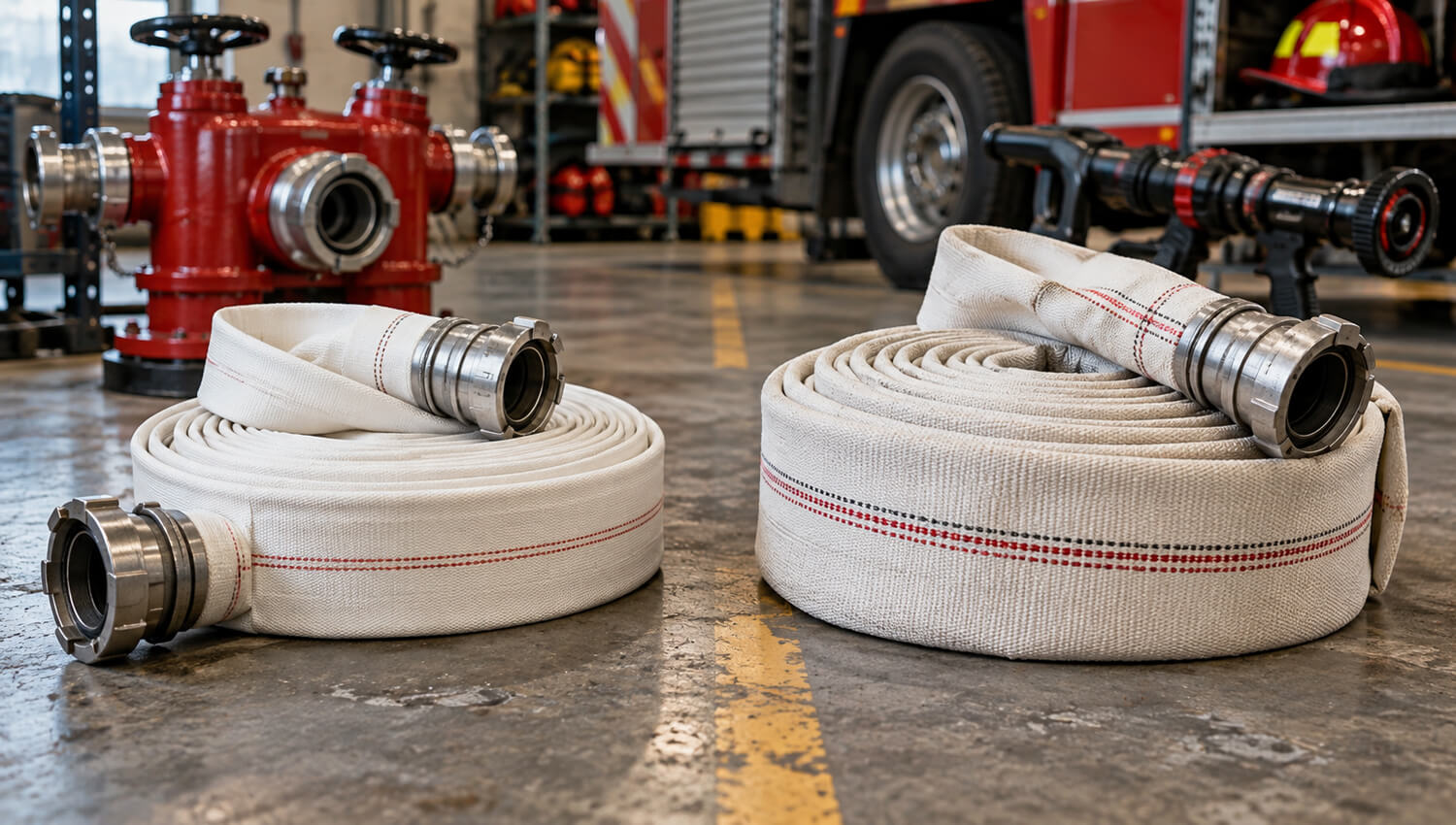
The biggest difference between these two designs is the number of woven protective layers.
A single jacket hose uses one fabric jacket around the inner lining. A double jacket hose uses two woven jackets, typically arranged as an inner and outer layer.
Both designs deliver water for fire protection. Yet their ability to handle rough conditions can differ considerably.
Technical Comparison Table
| الميزة | Single Jacket Hose | Double Jacket Hose |
|---|---|---|
| Woven jackets | One | Two |
| Basic construction | Lining + one jacket | Lining + inner and outer jackets |
| الوزن | Generally lighter | Generally heavier |
| Flexibility | Often easier to handle | Depends on design; may be stiffer |
| Abrasion protection | Lower in comparable designs | Generally higher |
| Pressure capability | Product-rating dependent | Product-rating dependent |
| Storage | Often more compact | May require more space |
| Purchase cost | Usually lower | Usually higher |
| Suitable environment | Protected or lighter-duty service | Demanding or repeated deployment |
| Common applications | Hydrants, standpipes, cabinets | Fire apparatus, industrial response |
| Long-term value | Good for limited wear | Strong for abrasive environments |
Comparison assumes similar hose diameter, lining, yarn quality, and manufacturing level. Individual products may differ.
Seven Essential Differences
Single jacket construction
One woven jacket protects the internal lining. It is often a practical option for equipment that remains stored until an emergency.
Double jacket construction
Two woven layers provide additional fabric protection, especially when the hose is deployed on abrasive surfaces.
The seven main purchasing differences are:
- Jacket structure: One woven layer versus two.
- Abrasion resistance: Double-layer construction generally offers stronger protection.
- Weight: Single-layer designs usually reduce carrying weight.
- Flexibility: Handling and bending depend on the complete hose structure.
- Pressure performance: The approved rating matters more than layer count alone.
- Purchase cost: Additional material and processing often increase price.
- Service suitability: Operating conditions determine which design offers better value.
Neither option is automatically right for every buyer.
A distributor supplying commercial building equipment may prioritize compact storage and price.
A contractor supplying a busy fire department may place greater value on abrasion protection and repeated use.
The best approach is to compare tested specifications and field requirements rather than judging the hose by appearance.
How Fire Hose Jacket Materials Affect Performance
Material selection plays a major role in fire hose performance. Two products with the same number of jackets may behave differently because their yarns, linings, and manufacturing methods are not identical.
For buyers, understanding the materials helps explain price differences between competing quotations.
Polyester and Woven Synthetic Jackets
Polyester is commonly used for woven fire hose jackets.
It offers useful tensile strength and resistance to moisture. It can also withstand repeated bending when the fabric structure is designed correctly.
Manufacturers may adjust the yarn size, weaving pattern, and fabric density to achieve specific performance targets.
A tighter or heavier weave may improve certain strength or abrasion properties. However, it can also increase weight and affect flexibility.
These design choices must be evaluated together.
Inner Lining Materials
The inner lining is responsible for keeping water inside the hose.
Common options include:
| Lining material | Main characteristics | Purchasing consideration |
|---|---|---|
| EPDM or other rubber compounds | Flexible, with properties depending on formulation | Verify aging, temperature, and adhesion performance |
| TPU | Good potential abrasion and mechanical performance | Check exact grade and hose construction |
| Other approved elastomers | Properties vary by formulation | Request tested compatibility and performance data |
A good lining needs more than water resistance.
It must also remain reliable during bending, pressure changes, and repeated handling.
Poor bonding between the lining and the jacket may lead to separation or reduced product performance.
How Manufacturing Quality Changes the Result
Fire hose production involves several connected operations.
These may include yarn preparation, weaving, lining manufacture, lining insertion or bonding, curing where applicable, inspection, and coupling assembly.
Each operation can affect the finished product.
For example, inconsistent weaving may create weak areas. Incorrect lining dimensions may affect assembly quality.
Uneven adhesive application or unsuitable processing conditions can also affect bonding.
This is why reliable hose evaluation requires more than a sample photograph.
When reviewing suppliers, request material specifications, construction details, and test records.
Ask whether the production sample will match the approved bulk-order specification.
A small material substitution can change flexibility, weight, and pressure performance.
Clearly defined materials help importers maintain consistent product quality across different shipments.
Working Pressure, Burst Pressure, and Hose Safety
Pressure ratings are among the most important factors when buying firefighting hose.
A stronger-looking hose isn’t necessarily approved for a higher operating pressure.
Each product has a defined pressure capability based on its materials, construction, and testing.
Understanding Important Pressure Ratings
Three terms commonly appear in hose specifications:
- Working pressure: The maximum pressure allowed during normal service under the manufacturer’s stated conditions.
- Proof test pressure: A specified test pressure used to check structural integrity.
- Burst pressure: The pressure at which a hose fails during a destructive test.
Some standards also define service test pressure, which must not be confused with normal working pressure or factory proof pressure.
These terms are not interchangeable.
For example, a hose with a high burst pressure should not automatically be used at that pressure.
The approved working rating and applicable standard control safe use.
Does a Double Jacket Mean Higher Pressure?
Not always.
Double-layer construction can help manufacturers design hoses with higher strength. However, the final pressure rating depends on the complete assembly.
UL 19 covers both single-jacketed and multiple-jacketed lined hoses.
Its scope identifies single-jacketed products intended for service test pressures starting at 150 psi and multiple-jacketed products starting at 200 psi, with additional rating increments. These are standard categories, not universal ratings for every hose.
What Should Buyers Verify?
Before approving a large order, confirm:
- Rated working or operating pressure
- Specified proof test pressure
- Burst test requirement
- Hose diameter and length
- Coupling attachment performance
- Applicable certification and test method
A supplier should identify which figures are guaranteed product ratings and which are typical laboratory results.
Important: A pressure value alone does not establish compliance with UL 19 or another standard.
For contractors and importers, the safest purchasing method is to request a technical datasheet and applicable test documentation.
This protects both the buyer and the final user from selecting an unsuitable product.
Abrasion Resistance, Durability, and Service Life
Fire hoses face many sources of wear.
They may be pulled across concrete, moved around equipment, exposed to weather, or stored for long periods.
Abrasion resistance becomes especially important when hoses are used repeatedly.
Why Double Jacket Construction Offers Extra Protection
In a typical double-layer hose, the outer jacket receives most of the initial surface contact.
The inner jacket provides another fabric layer beneath it.
This can reduce the chance that moderate surface wear will directly affect the inner lining.
The additional construction is useful where a hose frequently touches rough surfaces.
These environments include roads, industrial yards, and training grounds.
However, a second jacket does not make a hose resistant to every kind of damage.
Sharp metal edges, severe dragging, chemical exposure, and excessive heat can still damage the product.
What Affects Fire Hose Service Life?
There is no single service life that applies to every hose.
Actual durability depends on several factors:
| العامل | Possible effect on service life |
|---|---|
| Surface abrasion | Wears away protective yarns |
| Sharp objects | May cut jackets or damage linings |
| Repeated bending | Places stress on the hose structure |
| UV exposure | Can degrade certain materials |
| Chemical contact | May affect fabric, lining, or couplings |
| Poor drying | Can encourage contamination and deterioration |
| Improper storage | May create permanent deformation or damage |
The number of jackets is only one part of the picture.
A hose that’s rarely deployed may remain useful for a long period when properly inspected and maintained.
A similar hose used frequently on harsh surfaces may require replacement much sooner.
Improving Long-Term Durability
Buyers should consider the conditions under which the hose will operate.
For demanding environments, request abrasion test information and evidence of construction quality.
Also ask whether the manufacturer offers alternative fabric weights or protective surface treatments.
Maintenance is equally important.
After approved use, hoses should be cleaned, inspected, dried, and stored according to their manufacturer’s instructions and applicable standards.
They should also undergo the required periodic inspections and service testing.
A damaged hose must not be kept in service simply because it still holds water during a casual check.
For distributors, providing clear maintenance instructions can reduce product complaints and improve customer confidence.
Fire Hose Weight, Flexibility, and Handling
Fire hose weight affects transportation, storage, deployment, and daily handling.
These factors are easy to overlook when comparing technical datasheets.
Yet they can make a noticeable difference in real operating conditions.
Why Single Jacket Hoses Are Often Lighter
A single-layer hose uses less woven fabric than a comparable double-layer hose.
This usually reduces the dry weight.
Lower weight can be valuable when personnel must move multiple hose lengths or deploy equipment in restricted spaces.
It may also simplify packing and storage.
For importers, lower weight can affect shipping calculations, although the overall difference depends on packaging, couplings, and shipment volume.
A lighter design may therefore offer practical benefits for both handling and distribution.
Does Double Jacket Construction Reduce Flexibility?
Not necessarily.
An additional woven layer changes the hose structure, but flexibility also depends on fabric weave, lining material, coating, and diameter.
Some double-jacketed hoses remain highly flexible.
Other products may feel noticeably stiffer.
The correct way to assess flexibility is to examine the actual hose under representative conditions.
Important Handling Factors

Illustrative comparison only. Bar lengths are not measured product data.
During product evaluation, check the following:
- Dry weight per meter or standard hose length
- Rolled diameter and packing dimensions
- Ease of bending and folding
- Tendency to kink during use
- Handling when wet
- Compatibility with existing racks, reels, or storage cabinets
One of the most useful purchasing steps is to request physical samples.
Two hoses with similar specifications may feel different when rolled, connected, or deployed.
Sample evaluation helps buyers understand whether a product meets the practical needs of their customers.
For large orders, it also helps prevent disputes over weight, flexibility, and packaging expectations.
Best Applications for Single and Double Jacket Fire Hoses
Different fire protection environments place different demands on hose construction.
Choosing a suitable hose requires a clear understanding of where the product will be stored and how it will be used.
Single Jacket Fire Hose Applications
Single-layer designs are often suitable for controlled or protected locations.
تشمل التطبيقات الشائعة ما يلي:
- Fire hydrant systems
- Standpipe installations
- Selected fire hose cabinets
- المباني التجارية
- Warehouses with suitable operating conditions
- Emergency equipment with limited abrasion exposure
A single-layer hose may provide an effective balance of cost, weight, and required performance.
For instance, a building equipment distributor may require a lightweight hose for a protected standpipe installation.
If the hose meets the required standard and operating pressure, a double-layer design may offer little additional practical benefit.
However, the complete assembly must still be approved for the specific installation.
Double Jacket Fire Hose Applications
Double-layer designs are often selected for more demanding operations.
They are commonly considered for:
- Municipal firefighting equipment
- Fire engine hose loads
- Industrial emergency response teams
- Fire training facilities
- Industrial yards
- Locations with frequent hose movement
- Operating conditions involving repeated ground contact
For a municipal department, extra abrasion protection may be worth the additional weight.
For an industrial buyer, the decision may depend on exposure to rough floors, vehicle movements, or frequent drills.
Application Selection Chart
| التطبيق | Typical starting choice | Main reason |
|---|---|---|
| Protected standpipe | Single jacket | Lower weight and limited abrasion |
| Fire cabinet system | Single jacket, if approved | Compact storage |
| Municipal fire engine | Double jacket | Repeated deployment and wear |
| Industrial emergency team | Double jacket | Greater physical protection |
| Training ground | Double jacket | Frequent use |
| Occasional hydrant use | Single jacket | Practical cost-performance balance |
| Rough outdoor operation | Double jacket or suitable covered hose | Higher abrasion demands |
These recommendations are general guidance, not automatic approval for a specific installation.
A fire hose must satisfy local regulations, the system design, and the authority having jurisdiction.
In some locations, a covered hose or another specialist construction may be more suitable than either traditional jacket design.
The final selection should always start with the actual operating environment.
Fire Hose Standards and Quality Testing
Standards help buyers compare products using defined technical requirements.
They also provide a common language for manufacturers, testing organizations, engineers, and importers.
A fire hose should never be considered compliant based only on its appearance or a supplier’s verbal statement.
Important Standards for Fire Hoses
| قياسي | Main relevance |
|---|---|
| UL 19 | Lined fire hose and hose assembly requirements |
| NFPA 1960 | Manufacturing and product requirements covering fire hose, among other equipment |
| NFPA 1962 | Care, use, inspection, service testing, and replacement of fire hose and related equipment |
| EN 14540 | Non-percolating layflat hoses for fixed firefighting systems |
| EN 694 | Semi-rigid hoses for fixed firefighting systems |
Not every standard applies to every hose type.
For example, EN 694 concerns semi-rigid hose rather than conventional layflat jacketed attack hose.
Likewise, a product meeting a European specification should not automatically be described as UL Listed.
Understanding NFPA Requirements
The 2024 edition of NFPA 1960 consolidated several earlier product standards, including NFPA 1961.
This is important when preparing modern specifications for products intended for the North American market.
Buyers may still encounter older specifications referencing NFPA 1961.
In these cases, check the project requirements and applicable edition before updating the purchasing documents.
You can review the current standard information through the official NFPA 1960 standard page.
Which Factory Tests Matter?
Depending on the applicable standard and product design, quality checks may include:
- Dimensional measurements
- Visual inspection of jacket weaving
- اختبار الضغط الهيدروستاتيكي
- Burst testing on representative samples
- Lining adhesion testing
- Abrasion testing
- Coupling attachment checks
- Identification and labeling verification
A manufacturer’s quality control system should define when these tests occur and how results are recorded.
For international purchases, test traceability is especially valuable.
Documents should identify the product model, applicable standard, test method, and relevant results.
Buyer tip: Ask for a certificate or listing record that clearly matches the hose being purchased.
A generic certificate belonging to another model doesn’t prove the quoted product is certified.
Always verify certification status with the issuing organization when compliance is critical.
Fire Hose Cost Comparison and Long-Term Value
Purchase price is important, especially for distributors working with competitive tenders.
However, the lowest unit price may not produce the lowest long-term cost.
The better comparison considers the full cost of buying, stocking, maintaining, and replacing each hose.
Why Does Double Jacket Fire Hose Often Cost More?
A double-layer hose normally requires additional yarn and weaving work.
Its material consumption may be higher, and certain production steps can become more complex.
These factors often result in a higher factory price.
However, actual pricing also depends on hose diameter, lining type, coupling material, order quantity, certification, and packaging requirements.
A large order with standard specifications may have a very different cost structure from a small custom batch.
Comparing Total Cost of Ownership
Consider two purchasing situations.
Scenario A: Protected installation
A distributor supplies fire protection equipment for a commercial building.
The hose remains stored in a cabinet and is expected to face limited physical wear.
A compliant single-layer design may offer a lower initial cost without sacrificing required performance.
Scenario B: Frequent emergency response
An industrial response team regularly deploys hoses across concrete floors and outdoor yards.
In this environment, stronger abrasion protection may reduce damage and unplanned replacement.
A higher-priced double-layer design could provide better lifetime value.
Neither outcome is guaranteed. The actual result depends on usage, product quality, and maintenance.
A Practical Purchasing Formula
{Total Ownership Cost} = {Purchase Cost} + {Maintenance Cost} + {Replacement Cost} + {Other Operating Costs}
For wholesale buyers, freight, import duties, storage, testing, and warranty handling may also need consideration.
Questions to Ask Before Comparing Quotations
- Are both products the same diameter and length?
- Do they use comparable lining materials?
- Are the couplings included in both prices?
- Are the pressure ratings equivalent?
- Do the products meet the same required standard?
- What testing documents are included?
- How are replacement or warranty claims handled?
A price comparison is useful only when the technical requirements are comparable.
For wholesale evaluation, request a model-by-model technical datasheet and quotation. This makes it easier to compare hose constructions, pressure ratings, coupling options, and packaging specifications before committing to an order.
How to Choose a Reliable Fire Hose Manufacturer
For overseas buyers, selecting the right manufacturer is about more than product pricing.
Consistent quality, technical documentation, production capacity, and clear communication are equally important.
A dependable supplier should understand both the hose specification and the buyer’s target market.
Check Manufacturing and Quality Control Capabilities
Before placing an order, ask how the manufacturer controls the main production processes.
Important questions include:
- How are yarn and lining materials inspected?
- What checks are performed during weaving?
- How is the hose lining inspected or tested?
- Are pressure tests recorded and traceable?
- How are defective products identified?
- Are finished hose assemblies inspected before shipment?
Manufacturers should be able to explain their quality control procedures and provide supporting documentation.
Factory audits, sample inspections, and third-party testing may also be appropriate for larger contracts.
Evaluate OEM and Private Label Options
Many fire equipment distributors need products that match their existing catalogs and customer requirements.
Depending on the manufacturer’s capabilities, customization may include:
| Customization item | Possible options |
|---|---|
| Hose diameter | Standard or available custom sizes |
| طول الخرطوم | Project-specific cut lengths |
| Jacket color | White, red, yellow, or other available colors |
| Stripe design | Identification stripes or branding |
| Couplings | Compatible regional connection types |
| Lining material | Available rubber or thermoplastic options |
| Product marking | Brand, model, ratings, and traceability |
| التعبئة والتغليف | Neutral cartons or private label packaging |
Customization must not compromise certified construction or required product identification.
A change in materials, construction, or fittings may require further testing or certification review.
Prepare a Clear RFQ
An effective request for quotation should include the following information:
- Target country and applicable standard
- Single or double jacket construction
- Internal diameter and hose length
- Required pressure rating
- Lining material, if specified
- Coupling type and connection standard
- Estimated purchasing quantity
- OEM packaging or branding requirements
- Required documentation and delivery terms
Providing these details helps reduce quotation errors.
It also allows the manufacturer to identify technical problems before production begins.
For a new supplier, consider approving a pre-production sample against a written specification.
The approved sample can then serve as a reference for bulk-order inspections.
This process is particularly useful for distributors building a long-term product range.
الأسئلة الشائعة
Is double jacket fire hose better than single jacket fire hose?
Double jacket hose generally provides better abrasion protection because it uses two woven layers. However, single jacket hose may be more suitable for protected installations. The better choice depends on pressure requirements, operating conditions, weight, and budget.
Can single jacket fire hose be used for firefighting?
Yes. Single jacket hose can be used in approved firefighting applications, including suitable hydrant and standpipe systems. It must meet the applicable technical requirements. It is generally less suitable for repeated dragging across rough or sharp surfaces.
Does double jacket fire hose have a higher burst pressure?
Not automatically. Two woven layers can support a stronger design, but burst pressure depends on yarn strength, weave construction, lining, and manufacturing quality. Buyers should compare tested pressure ratings rather than assume that jacket count guarantees performance.
What is the most common material for a jacketed fire hose?
Polyester is widely used for woven fire hose jackets because it offers useful mechanical strength and moisture resistance. Inner linings may use rubber or thermoplastic materials. Exact material selection depends on the required hose design and applicable standard.
Which fire hose is better for industrial applications?
Double jacket hose is often preferred where equipment faces repeated movement and surface abrasion. However, some industrial environments require specialized covered hoses or chemical-resistant constructions. The final choice should account for hazards, pressure, exposure, and compliance requirements.
Can single jacket and double jacket hoses use the same couplings?
They may use the same coupling type when the hose dimensions, fitting design, and attachment method are compatible. However, coupling suitability must be verified for the specific assembly. A matching nominal diameter alone is not enough to confirm compatibility.
How can importers verify fire hose quality before shipment?
Importers can request approved samples, technical datasheets, test records, and applicable certification documents. They may also arrange pre-shipment inspections or independent testing. The inspection should confirm that bulk products match the approved specification and required markings.
What information should buyers provide for an OEM fire hose quotation?
Buyers should provide the hose diameter, length, jacket construction, pressure requirements, coupling type, destination market, estimated quantity, and branding needs. These details help manufacturers prepare accurate quotations and identify whether additional testing or certification is needed.
Conclusion: Choosing the Right Fire Hose
Single jacket and double jacket fire hoses serve different purchasing and operating needs.
A single-layer hose offers a practical combination of lower weight, compact handling, and competitive pricing. It can be a suitable choice for approved fire protection installations with limited abrasion exposure.
A double-layer hose provides additional fabric protection. It is often worth considering for municipal firefighting, industrial emergency response, and repeated deployments in demanding environments.
However, the number of jackets should never replace proper technical evaluation.
Pressure ratings, lining construction, coupling compatibility, quality testing, and applicable standards are all essential.
For distributors, importers, and contractors, the most effective purchasing strategy is to compare products against a clearly defined specification.